
Cylindromyia
Meigen, 1803
Species Guides
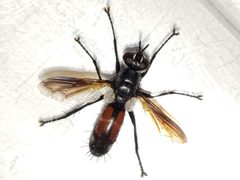
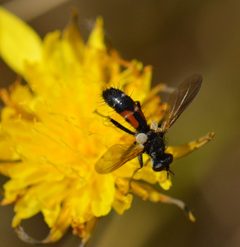
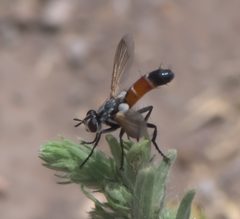
6A large of tachinid flies comprising over 100 across multiple subgenera. Species are , with documented associations with true bugs (Hemiptera), particularly stink bugs (Pentatomidae). Cylindromyia bicolor has been recorded as an parasitoid of the pest Halyomorpha halys and the native Rhaphigaster nebulosa. Antennal in C. interrupta include trichoid and coeloconical types that function in and mate location.
Pronunciation
How to pronounce Cylindromyia: //sɪˌlɪndɹəˈmaɪə//
These audio files are automatically generated. While they are not always 100% accurate, they are a good starting point.
Images
Distribution
Recorded from northern Europe (Denmark, Norway, Sweden), North America (Vermont, United States), northern Türkiye (Borçka, Artvin), Russia (Voronezh Region), and China (Guiyang).
Host Associations
- Halyomorpha halys - First world record; reared from in northern Türkiye
- Rhaphigaster nebulosa - -parasitic relationship documented in Voronezh Region, Russia
Behavior
Orientation mediated by antennal , including search for sexual partners, potential , and hosts.
Ecological Role
of true bugs (Hemiptera), with potential as agent for pest such as Halyomorpha halys.
Human Relevance
Cylindromyia bicolor shows potential for of the brown marmorated stink bug Halyomorpha halys, a significant agricultural pest affecting vegetables, field crops, and tree fruits.
Sources and further reading
- BugGuide
- Wikipedia
- GBIF taxonomy match
- iNaturalist taxon
- NCBI Taxonomy
- Catalogue of Life
- First record of Cylindromyia bicolor (Diptera: Tachinidae) as an adult parasitoid of Halyomorpha halys (Heteroptera: Pentatomidae) in the world Halyomorpha halys’ın (Hemiptera: Pentatomidae) ergin parazitoiti olarak Cylindromyia bicolor'un (Diptera: Tachinidae) dünyadaki ilk kaydı
- Ultrastructure of antennal sensilla of <i>Cistogaster globosa</i> (Fabricius, 1775) и <i>Cylindromyia interrupta</i> (Meigen, 1824) (Diptera: Tachinidae)
- The first record of Rhaphigaster nebulosa (Poda, 1761) (Heteroptera: Pentatomidae) for Voronezh Region and notes about the host-parasitic relationships with Cylindromyia bicolor (Olivier, 1812) (Diptera: Tachinidae)
- Complete mitochondrial genome of Cylindromyia (Calocyptera) intermedia from Guiyang, China, and phylogeny of Phasiinae (Diptera: Tachinidae).