
Cylindromyia interrupta
(Meigen, 1824)
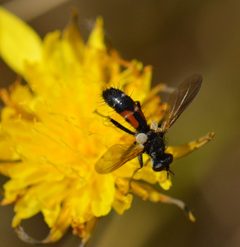
Cylindromyia interrupta is a small tachinid fly, 6–8 mm in length with a wingspan of 12 mm. It is a whose larvae develop inside living , specifically and true bugs (Hemiptera). are active from May to August and feed primarily on nectar and pollen of Apiaceae, especially Leucanthemum vulgare. The is distinguished by its slender body with black , reddish bearing two silver rings, a wide longitudinal black marking, and black tergites.
Pronunciation
How to pronounce Cylindromyia interrupta: /sɪˌlɪndroʊˈmaɪə ɪnˌtɛrəpˈtə/
These audio files are automatically generated. While they are not always 100% accurate, they are a good starting point.
Identification
Slender body, 6–8 mm length, wingspan 12 mm. black; reddish with two silver rings, wide longitudinal black marking, and black tergites. Hind tibiae with 1–2 posteroventral bristles. Apical scutellars absent. Abdomen with discal bristles on tergites 1–4. Bright white calypteres conspicuous.
Images
Habitat
Hedge rows and dry meadows.
Distribution
Europe (most of Europe, Russia), North America (Alaska to California, North Dakota, Colorado, New Jersey).
Seasonality
active May to August.
Diet
feed on nectar and pollen of Apiaceae, especially Leucanthemum vulgare.
Host Associations
- Moths - Larvae develop inside living
- True bugs (Hemiptera) - Larvae develop inside living
Life Cycle
Larvae develop inside living ( and Hemiptera).
Ecological Role
of and true bugs.
Sources and further reading
- BugGuide
- Wikipedia
- GBIF taxonomy match
- iNaturalist taxon
- NCBI Taxonomy
- Bug Eric: Last Night to Blacklight?
- Arkansas | Beetles In The Bush | Page 2
- flies | Beetles In The Bush | Page 6
- Ultrastructure of antennal sensilla of <i>Cistogaster globosa</i> (Fabricius, 1775) и <i>Cylindromyia interrupta</i> (Meigen, 1824) (Diptera: Tachinidae)