
Taxigramma hilarella
(Zetterstedt, 1844)
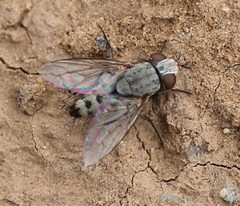
Taxigramma hilarella is a of satellite fly in the Sarcophagidae, Miltogramminae. These flies are kleptoparasites that target the nests of solitary , particularly beewolves (Philanthus spp.). Females follow wasps back to their burrows and deposit larvae at the nest entrance; the larvae then enter and parasitize the wasp larvae. The species has been recorded from Scandinavia and Denmark.
Pronunciation
How to pronounce Taxigramma hilarella: /ˌtæksɪˈɡræmə ˌhɪləˈrɛlə/
These audio files are automatically generated. While they are not always 100% accurate, they are a good starting point.
Identification
Miltogrammine sarcophagids can be distinguished from other flesh flies by their reduced mouthparts and of following . Specific identification of T. hilarella likely requires examination of genitalia and comparison with related Taxigramma .
Images
Habitat
Associated with sandy or coarse soil where beewolves nest; found in areas with bare ground suitable for burrow excavation.
Distribution
Recorded from Denmark, Norway, and Sweden.
Diet
Larvae are of solitary larvae, specifically documented as of beewolf (Philanthus) larvae. feeding habits are not documented.
Host Associations
- Philanthus gibbosus - Larvae parasitize beewolf larvae in their underground nests
- Philanthus spp. - General association with beewolf
Life Cycle
Females deposit larvae at the entrance of nests; larvae crawl down the burrow and parasitize the larval wasps. Developmental details beyond this initial stage are not documented.
Behavior
Females exhibit kleptoparasitic by following female beewolves back to their nests. This satellite-following behavior allows them to locate nests without excavating or searching independently.
Ecological Role
of solitary ; acts as a control agent for beewolf wasps.
Similar Taxa
- Metopia spp.Also satellite flies that parasitize beewolves; belong to same Miltogramminae but differ in and specific associations
- Senotainia spp.Another of miltogrammine satellite flies that target beewolf nests; distinguished by genitalia and subtle morphological differences