
Scathophaginae
dung flies, yellow dung flies
Genus Guides
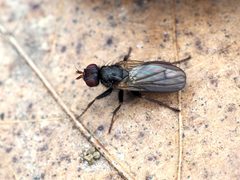
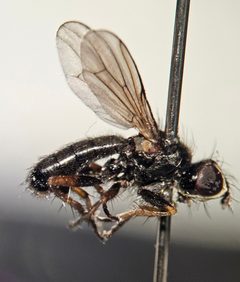
13Scathophaginae is a of predatory flies within the Scathophagidae, commonly known as dung flies. The subfamily contains at least 30 and approximately 130 described . are frequently associated with and decaying organic matter, where they occur in large numbers. The group is notable for being predatory rather than , with both adults and larvae feeding on other insects.

Pronunciation
How to pronounce Scathophaginae: /ˌskæθoʊfəˈdʒaɪniː/
These audio files are automatically generated. While they are not always 100% accurate, they are a good starting point.
Identification
Members of Scathophaginae can be distinguished from the other of Scathophagidae, Delininae, by morphological features including genitalic structures and chaetotaxy. are generally robust flies with yellowish to brownish coloration. The subfamily is characterized by predatory mouthparts adapted for capturing prey rather than sponging or lapping structures found in many other calyptrate flies.
Images
Habitat
are commonly found in with abundant , including pastures, meadows, and areas with livestock or wild mammal activity. Larvae develop in dung and decaying organic matter. The group shows preference for moist, decomposing substrates that support of prey organisms.
Distribution
The has a primarily Holarctic distribution, with occurring across North America, Europe, and Asia. Some species have broader ranges extending into other regions. Individual and species show varying geographic limits.
Seasonality
Activity patterns vary by and latitude. In temperate regions, are most abundant during spring and summer months when accumulation and prey availability are highest. Some species have extended periods from early spring through autumn.
Diet
Both and larvae are predatory. Adults capture and consume other insects, particularly small Diptera. Larvae prey on other dipteran larvae and inhabiting and decaying matter. The does not feed directly on dung despite common association with this substrate.
Life Cycle
are deposited in or decaying organic matter. Larvae pass through three instars while preying on other in the substrate. occurs within or near the larval . Development rate varies with temperature and prey availability. emerge to mate and continue the predatory lifestyle.
Behavior
are active that hunt on and around pats. Males frequently establish territories on fresh dung and engage in aggressive interactions with conspecifics. Both sexes are attracted to dung for mating, oviposition, and foraging. Some form dense on suitable substrates.
Ecological Role
As in , Scathophaginae help regulate of other dipteran and in decomposition systems. They contribute to nutrient cycling indirectly by controlling herbivore and populations. The serves as prey for larger invertebrates and vertebrates.
Human Relevance
Some , particularly Scathophaga stercoraria (yellow dung fly), serve as model organisms in studies of , sperm competition, and behavioral . The group has been investigated for potential use in of pest flies in livestock operations. They are common subjects in ecological research on .
Similar Taxa
- DelininaeThe other of Scathophagidae, distinguished by different genitalic and larval ; Delininae larvae are phytophagous or feed on decaying plant matter rather than being predatory.
- Muscidae of calyptrate flies including house flies; many muscids are saprophagous or and share , but lack the robust predatory and of Scathophaginae.
- SarcophagidaeFlesh flies that overlap in ; distinguished by checkerboard abdominal pattern, different larval (typically or saprophagous), and three-segmented .
Misconceptions
Despite the "dung flies," Scathophaginae are not . Both and larvae are , and their association with reflects hunting and oviposition site selection rather than direct consumption of fecal matter. This distinction is frequently misunderstood.
More Details
Research significance
Scathophaga stercoraria, a member of this , is one of the most intensively studied insects in behavioral . Research on this has generated foundational insights into sperm competition, mate choice, and phenotypic plasticity in response to environmental conditions.
Systematic status
The classification of Scathophagidae has undergone revision, with Scathophaginae representing the larger and more -rich of the two recognized . The subfamily Delininae contains fewer and exhibits different ecological characteristics.