
Scathophaga stercoraria
(Linnaeus, 1758)
yellow dung fly, golden dung fly
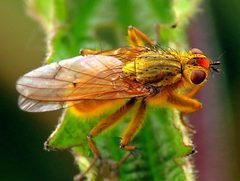
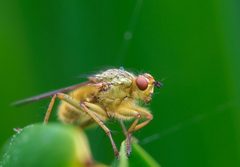
Scathophaga stercoraria, commonly known as the yellow or golden dung fly, is a widespread and abundant dipteran found across the Northern Hemisphere. are sexually dimorphic: males display bright golden-yellow coloration with orange-yellow fur on the front legs, while females are duller with green-brown tinges and lack the brightly colored leg fur. The species is strongly associated with the of large mammals, where it breeds and where males establish territories to intercept females. Adults are predatory, feeding on smaller insects and occasionally nectar, while larvae are , developing within dung. The species has become an important model organism in evolutionary , particularly for studies of , sperm competition, and evolution.

Pronunciation
How to pronounce Scathophaga stercoraria: //skæˈθɒfəɡə stɛrkəˈræriə//
These audio files are automatically generated. While they are not always 100% accurate, they are a good starting point.
Identification
Males are readily identified by their bright golden-yellow coloration and dense covering of long hairs, combined with orange-yellow fur on the front legs. Females are more subdued in coloration with green-brown tones and lack the distinctive leg fur. The can be distinguished from other Scathophaga species by the combination of golden coloration, association with large mammal , and the specific pattern of . Similar species in the may overlap in distribution but typically differ in color intensity and leg ornamentation.
Images
Appearance
range from 5 to 11 mm in length, with males generally larger than females. Males are bright golden-yellow with dense, long yellow hairs covering the body, and possess orange-yellow fur on the front legs. Females are smaller, duller in coloration with pronounced green-brown tinges, and lack the brightly colored fur on the front legs. The body is covered in long, golden hairs that give the male its characteristic glowing appearance in sunlight. Physical features vary considerably among due to the broad geographic range and environmental conditions.
Habitat
Primarily associated with pastures, agricultural grasslands, meadows, forest edges, and ranches where large mammals (cattle, horses, sheep, deer, wild boar) are present. The requires fresh pats for breeding, with optimal conditions found in cooler temperate regions. range from lowland pastures to higher elevations including the Pyrenees and Swiss Alps. Human agriculture has significantly influenced distribution, particularly in northern Europe and North America.
Distribution
Widespread across the Northern Hemisphere including North America, Europe, and Asia. Found in cooler temperate regions generally, with extending to higher altitudes in mountainous areas. Distribution has been expanded and modified by human agricultural practices, especially livestock farming. Records from the Afrotropical region have been reclassified as the distinct sister Scathophaga soror.
Seasonality
are active throughout much of the year in moderate climates, with peak abundance in spring (March–May) and autumn. In warmer climates, decline sharply when temperatures exceed 25°C. In colder climates such as Iceland, Finland, and northern England, no summer population decline occurs. Typically 2–4 overlapping per year, varying with altitude and latitude. First synchronized with end of winter (March in northern Europe), with generations produced in fall.
Diet
are primarily predatory, feeding on smaller insects—mostly other Diptera. They also consume nectar and as supplementary energy sources. In laboratory settings, adults can survive on Drosophila and water alone. Females spend most of their time foraging in vegetation, visiting dung only to mate and oviposit. Males spend most of their time on dung, waiting for females and feeding on other insects that visit dung, such as blow flies. has been observed when other prey is absent. Larvae are , feeding exclusively on dung.
Life Cycle
hatch into larvae after 1–2 days depending on temperature. Larvae quickly burrow into for protection and feed on it. At 20°C, larvae undergo three over five days with . Following growth, larvae spend another five days emptying their stomachs before . Larvae then burrow into soil around and beneath dung to pupate after 10–20 days. varies from 10 days at 25°C to 80 days at 10°C or less. Females typically emerge a few days before males. of offspring depends heavily on dung quality including water content, nutritional quality, , and veterinary drug residues. are anautogenous, requiring protein from prey to become sexually mature and produce viable . Females can produce 4–10 clutches in their lifetime.
Behavior
Males establish territories on fresh pats and defend them against other males. They intercept females arriving to oviposit, often engaging in prolonged copulation (20–50 minutes) followed by mate guarding. Both sexes frequently mate with multiple partners. Females exhibit cryptic female choice through active sperm transport into spermathecae after copulation. Females preferentially oviposit on small hills of the dung surface, avoiding depressions and pointed areas to prevent desiccation and drowning. Both sexes are attracted to dung by scent and approach against the wind. When not breeding, females forage in vegetation while males remain near dung.
Ecological Role
Important decomposer in -based , contributing to dung degradation and nutrient cycling in pasture . Predatory help regulate of other dipterans. The serves as prey for birds, bats, and other insects. Larval development in dung contributes to soil nutrient enrichment through bioturbation and decomposition processes.
Human Relevance
Important model organism for scientific research due to short , susceptibility to experimental manipulation, and ease of laboratory culture. Has contributed significant knowledge about animal , , sperm competition, reproductive physiology, thermal , and genetics. Approved as a standard test for ecotoxicological testing of veterinary drug residues in livestock . Potential biocontrol agent against pest flies around livestock. may passively contaminate human food with , molds, or yeasts.
Similar Taxa
- Scathophaga sororFormerly considered or a ; molecular evidence confirms it as a distinct sister found in the Afrotropical region, separable by and geographic distribution
More Details
Model Organism Significance
Scathophaga stercoraria has been used in research for over 40 years, contributing to understanding of multiple mating systems, sperm competition, sexual conflict, and phenotypic plasticity. Its short lifespan, ease of laboratory rearing, and observable reproductive make it ideal for experimental studies.
Phenotypic Plasticity
The exhibits extreme phenotypic plasticity in body size and development rate in response to nutrition, temperature, , and genetic variation. This plasticity allows to unpredictable ecological conditions without requiring genetic adaptation.
Sexual Conflict and Sperm Competition
Research has documented extensive sexual conflict including post-copulatory , sperm competition, and cryptic female choice. Larger males have advantages in sperm displacement, while females control sperm storage through muscular spermathecal invagination, representing an evolutionary arms race between sexes.
Sources and further reading
- BugGuide
- Wikipedia
- GBIF taxonomy match
- iNaturalist taxon
- NCBI Taxonomy
- Catalogue of Life
- Winning PBESA Images: A Damselfly, a Blowfly and a Monarch | Bug Squad
- 2023: These Are a Few of My Favorite Things | Bug Squad
- Bug Eric: What's on Dat Scat?
- Bug Eric: February 2014
- Scathophagidae | Beetles In The Bush
- Orobanchaceae | Beetles In The Bush
- Sex and immunity in the yellow dung fly Scathophaga stercoraria
- Oviposition Site Choice in the Yellow Dung Fly Scathophaga stercoraria
- Antennal sensory organs of Scathophaga stercoraria (Linnaeus, 1758) (Diptera: Scathophagidae): ultramorphology and phylogenetic implications
- Biologia y actividad imaginai de Scathophaga stercoraria (Linnaeus, 1758), en un encinar mediterraneo (Diptera, Scathophagidae)
- Altitudinal life history variation in the dung flies Scathophaga stercoraria and Sepsis cynipsea
- Male Distribution and Mate Searching in the Yellow Dung Fly Scathophaga stercoraria: Comparison between Paired and Unpaired Males
- Systematic ambiguity in the well-established model system insect Scathophaga stercoraria (Diptera: Scathophagidae): sister species S. soror revealed by molecular evidence
- Developmental stability in yellow dung flies (Scathophaga stercoraria): fluctuating asymmetry, heterozygosity and environmental stress
- The causes of seasonal changes in numbers of the yellow dung fly, Scathophaga stercoraria (Diptera: Scathophagidae)
- The heritability of sexually dimorphic traits in the yellow dung fly Scathophaga stercoraria (L.)
- Sperm Storage in the Yellow Dung Fly Scathophaga stercoraria: Identifying the Sperm of Competing Males in Separate Female Spermathecae
- Temperature‐mediated seasonal variation in phosphoglucomutase allozyme frequency in the yellow dung fly, Scathophaga stercoraria