
Scathophaga
Meigen, 1803
Dung Flies, Yellow Dung Flies
Species Guides
8Scathophaga is a of small to medium-sized predatory flies in the Scathophagidae, commonly known as dung flies. The genus includes approximately 99 described , with Scathophaga stercoraria (the yellow dung fly) being the most extensively studied as a model organism in behavioral and evolutionary . are typically found in association with animal , where they engage in complex mating systems involving intense male-male competition and female mate choice. Larvae develop within dung or decaying organic matter, where they feed predaciously on other insect larvae.

Pronunciation
How to pronounce Scathophaga: //ˌskæθəˈfeɪɡə//
These audio files are automatically generated. While they are not always 100% accurate, they are a good starting point.
Identification
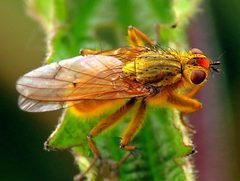
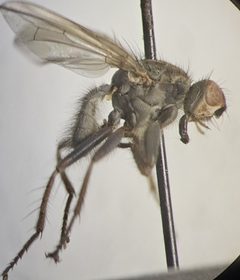
Members of Scathophaga can be recognized by their association with and predatory . Scathophaga stercoraria males are covered in long, bright yellow or golden hair that gives them a distinctive glowing appearance in sunlight; females are typically smaller and dull brown or gray. The exhibits notable in size and coloration. Some produce small, infertile males that superficially resemble females. Positive identification to species often requires examination of genitalia or molecular analysis, as cryptic species exist within the genus.
Images
Habitat
Primarily associated with animal pats, especially fresh cow and horse manure. Also found in decaying vegetable matter. frequently visit flowers, particularly willow catkins in early spring, where they feed on nectar and prey on smaller flies.
Distribution
Widespread across the Holarctic region, with records from North America (including Vermont), Europe (Denmark, Norway, Sweden), and extending into the Afrotropical region. Individual show varying distributions; Scathophaga stercoraria has nearly worldwide distribution in temperate regions.
Seasonality
Most conspicuous in spring and autumn, with multiple throughout warmer months. activity influenced by temperature, relative humidity, and precipitation.
Diet
are predatory, feeding on other small flies. They also consume nectar from flowers. Larvae are predacious, feeding on other insect larvae within or decaying organic matter.
Life Cycle
Females oviposit in pats, with placement influenced by surface topography—preferring small hills and avoiding depressions and points to optimize offspring survival. Larvae develop within the dung, feeding predaciously on other insect larvae. Developmental rate and traits vary with altitude and environmental conditions.
Behavior
Males engage in intense competition for access to females on pats, with larger males typically more successful. Males defend territories on fresh dung and may mistake other males for females in mating frenzies, repelling unwanted advances by kicking with their middle legs. Females exhibit cryptic female choice through selective sperm storage in three to four spermathecae, with the last male to mate fertilizing approximately 80% of . Males guard females during oviposition, which averages 45 minutes. Females make subtle decisions about oviposition site placement to maximize reproductive success.
Ecological Role
of other insects in ; larvae help regulate of other dung-inhabiting insects. contribute to pollination through flower visitation. Serve as food sources for other predators including jumping spiders.
Human Relevance
Scathophaga stercoraria is a well-established model organism in studies of , sperm competition, cryptic female choice, and evolutionary . The is easily observed and propagated in laboratory settings, making it valuable for student instruction and scientific research.
Similar Taxa
- SepsidaeBlack scavenger flies are also common on but are smaller, -waisted, and exhibit distinctive 'rowing' wing movements while . Sepsids lack the bright golden coloration of male Scathophaga stercoraria.
- CalliphoridaeBlow flies are abundant on but are typically metallic green or blue, lack the fuzzy golden appearance of Scathophaga males, and are not predatory as —they feed on liquid resources rather than capturing other flies.
- SarcophagidaeFlesh flies may occur on but are generally gray with black thoracic stripes and red ; they larviposit rather than oviposit, and lack the bright coloration and dense hair of Scathophaga.
Sources and further reading
- BugGuide
- Wikipedia
- GBIF taxonomy match
- iNaturalist taxon
- NCBI Taxonomy
- Catalogue of Life
- Winning PBESA Images: A Damselfly, a Blowfly and a Monarch | Bug Squad
- 2023: These Are a Few of My Favorite Things | Bug Squad
- Bug Eric: Spider Sunday: Phidippus asotus
- Bug Eric: What's on Dat Scat?
- Bug Eric: February 2014
- Bug Eric: April 2012
- Sex and immunity in the yellow dung fly Scathophaga stercoraria
- Oviposition Site Choice in the Yellow Dung Fly Scathophaga stercoraria
- Antennal sensory organs of Scathophaga stercoraria (Linnaeus, 1758) (Diptera: Scathophagidae): ultramorphology and phylogenetic implications
- Biologia y actividad imaginai de Scathophaga stercoraria (Linnaeus, 1758), en un encinar mediterraneo (Diptera, Scathophagidae)
- Altitudinal life history variation in the dung flies Scathophaga stercoraria and Sepsis cynipsea
- Male Distribution and Mate Searching in the Yellow Dung Fly Scathophaga stercoraria: Comparison between Paired and Unpaired Males
- Systematic ambiguity in the well-established model system insect Scathophaga stercoraria (Diptera: Scathophagidae): sister species S. soror revealed by molecular evidence
- Developmental stability in yellow dung flies (Scathophaga stercoraria): fluctuating asymmetry, heterozygosity and environmental stress