
Mansonia titillans
(Walker, 1848)
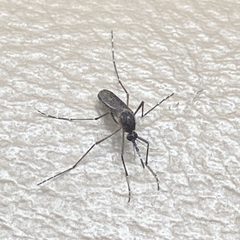
Mansonia titillans is a neotropical mosquito in the tribe Mansoniini. It is the most abundant Mansoniini species in central Florida phosphate regions and has shown recent northern range expansion into South Carolina. The species is distinguished by its unique underwater oviposition , where females deposit on the undersurfaces of aquatic plant leaves. Larval development occurs in association with floating vegetation, particularly water lettuce (Pistia stratiotes) and water hyacinth (Eichhornia crassipes).
Pronunciation
How to pronounce Mansonia titillans: /mænˈsoʊniə tɪˈtɪlænz/
These audio files are automatically generated. While they are not always 100% accurate, they are a good starting point.
Images
Habitat
Freshwater supporting emergent floating vegetation, particularly water lettuce (Pistia stratiotes) and water hyacinth (Eichhornia crassipes). stages are closely associated with the roots and undersurfaces of these aquatic plants.
Distribution
Neotropical region with records from Brazil (Espírito Santo, Paraná, Rondônia), Caribbean, Middle America, and North America. In the United States, documented in central Florida phosphate region and recently expanded northward to South Carolina (Beaufort, Berkeley, Clarendon, Colleton, and Georgetown counties).
Seasonality
Peak abundance observed June–July in central Florida. collected August–December in South Carolina.
Life Cycle
are deposited underwater on undersurfaces of aquatic plant leaves, enveloped in an air bubble transported on the female's hydrofuge . Larvae and pupae attach to submerged roots of floating vegetation for respiration, piercing plant tissues to access air.
Behavior
Females exhibit symmetrical abdominal stroking during oviposition: outstrokes consist of scratching with tergal spines to abrade the leaf surface, while instrokes (of longer duration) deposit glued rows. This underwater oviposition is homologous to the free-floating egg raft construction seen in Culex and Culiseta.
Similar Taxa
- Mansonia dyariSympatric in Florida phosphate region; M. titillans was more abundant (66% of Mansoniini collected vs. lower abundance for M. dyari)
- Mansonia humeralisNeotropical with similar aquatic plant associations; distinguished by cytogenetic differences in arm lengths and C-band distribution
- Mansonia pseudotitillansClosely related with karyotypic differences in average arm lengths relative to the
Sources and further reading
- BugGuide
- Wikipedia
- GBIF taxonomy match
- iNaturalist taxon
- NCBI Taxonomy
- An Mosquito Mansonia titillans (Walker) (Insecta: Diptera: Culicidae: Culicinae: Mansoniini)
- A quantitative analysis of underwater oviposition by the mosquito Mansonia titillans
- Seasonal and Spatial Distribution of Mansonia Dyari, Mansonia Titillans, and Coquillettidia Perturbans (Diptera: Culicidae) in the Central Florida, USA, Phosphate Region1
- New County Records Demonstrating a Northern Expansion of Mansonia titillans in South Carolina, USA
- Caracterização molecular de microbiomas bacterianos associados a mansonia humeralis (diptera: culicidae), e determinação cariotípica do grupo mansonia spp., rio madeira, amazônia ocidental