
Culiseta melanura
(Coquillett, 1902)
black-tailed mosquito, dark-tailed mosquito
Culiseta melanura, the black-tailed mosquito, is a North American mosquito and the primary enzootic of virus (EEEV). females feed almost exclusively on birds, with strong preferences for species such as wood thrush, American robin, and northern cardinal. The species maintains EEEV transmission among avian throughout its range in eastern and central North America. In Florida, persist year-round in wet tree holes, serving as a that may reseed northern populations annually.
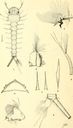
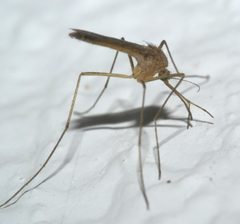
Pronunciation
How to pronounce Culiseta melanura: /ˌkjuːlɪˈsiːtə ˌmɛləˈnjʊərə/
These audio files are automatically generated. While they are not always 100% accurate, they are a good starting point.
Images
Habitat
Larval development occurs in standing water, particularly in wet tree holes that persist through dry seasons. In Florida, hardwood outland swamps and tree plantations with persistent wet tree holes represent high-risk . The has also been documented in urban habitats including impounded streams and concrete-lined pits.
Distribution
Eastern and central United States; forested regions of eastern North America. Present in Middle America and North America. Documented in Florida, Georgia, Michigan, New York, Connecticut, Illinois, and Massachusetts.
Seasonality
In northern regions, active primarily during warmer months with peaks in late summer. In Florida, populations persist year-round with reduced abundance in winter; concentrate in protected tree holes during winter months when falls below 12 hours.
Diet
females feed on vertebrate blood; males feed on nectar. Blood meals are obtained almost exclusively from avian (94.2% of meals in one New York study). Documented avian hosts include wood thrush, American robin, northern cardinal, song sparrow, ovenbird, red-eyed vireo, common yellowthroat, and chipping sparrow. Rare mammalian blood meals (0.8%) include white-tailed deer, horse, domestic cat, and eastern pipistrelle bat.
Host Associations
- Wood thrush - primary blood meal 23.6% of blood meals in New York; 30.9% for Culiseta morsitans
- American robin - primary blood meal major in Michigan and New York studies
- Northern cardinal - preferred blood meal major in Florida and Michigan; 42% of blood meals in Michigan study combined with American robin
- Chipping sparrow - blood meal migratory that may facilitate viral transport
- White-tailed deer - incidental blood meal rare mammalian feeding; potential bridge to transmission
Life Cycle
Complete with , larval, pupal, and stages. Larvae develop in standing water, particularly in tree holes and similar small water collections. occurs as adults in protected such as tree holes; in Florida, wet tree holes serve as year-round larval and adult refugia.
Behavior
Females blood-feed primarily on birds and seek resting shelters for maturation. demonstrate seasonal shifts in use, concentrating in tree holes during winter months in subtropical regions.
Ecological Role
Primary enzootic of virus (EEEV), maintaining virus circulation among avian . The is not considered a significant bridge vector to mammals; other mosquito (Aedes, Coquillettidia, Culex) are responsible for transmitting EEEV from birds to mammals.
Human Relevance
Major public health significance as the principal of EEEV, a highly pathogenic with approximately 50% fatality rate in symptomatic human cases. Management efforts target larval in tree holes, particularly winter spot treatments in Florida to reduce spring peaks and potential northward viral transport by migrating birds.
Similar Taxa
- Culiseta morsitansSympatric with similar and ; both feed primarily on wood thrush and other passerine birds, though Cs. morsitans shows slightly higher rates of mixed avian-mammalian blood meals (11.5% vs. 5.0%)
- Culex erraticusShares EEEV status and gopher tortoise burrow association in Florida, but belongs to different with distinct larval preferences
More Details
Viral fitness effects
EEEV reduces Culiseta melanura , decreasing survival and . This has not attenuated over 55 years of virus isolation, challenging traditional views of -virus toward benign associations.
Microbial associates
Field-collected harbor diverse bacterial dominated by commonly found in other mosquito , suggesting stable mosquito-microbe associations established after environmental acquisition.
Sources and further reading
- BugGuide
- Wikipedia
- GBIF taxonomy match
- iNaturalist taxon
- NCBI Taxonomy
- Meloidae Holdings | Entomology Research Museum
- Culiseta melanura mosquito bird hosts - Entomology Today
- How Florida Mosquito Control Could Trim Disease in Northern States
- Mosquito Populations Linked Across Further Distances Than the Viruses They Carry
- Some Florida Mosquitoes Spend the Winter in Tortoise Burrows
- tree hole with mosquito larvae - Entomology Today
- Dark-Tailed Mosquito Culiseta melanura (Coquillett) (Insecta: Diptera: Culicidae)
- Reduction of Culiseta melanura fitness by eastern equine encephalomyelitis virus.
- Swamp Mosquito, Culiseta melanura : Occurrence in an Urban Habitat
- MOLECULAR IDENTIFICATION OF BLOOD-MEAL SOURCES IN CULISETA MELANURA AND CULISETA MORSITANS FROM AN ENDEMIC FOCUS OF EASTERN EQUINE ENCEPHALITIS VIRUS IN NEW YORK
- Blood-Meal Hosts of the Enzootic Vector of Eastern Equine Encephalomyelitis Virus, Culiseta melanura, in Michigan, United States
- The Distribution and Development of Eastern Equine Encephalitis Virus in its Enzootic Mosquito Vector, Culiseta Melanura
- Update on the distribution of Culiseta melanura in regions of Illinois with prior eastern equine encephalitis virus activity
- Microbial communities within field‐collected Culiseta melanura and Coquillettidia perturbans
- Vector-Host Interactions of Culiseta melanura in a Focus of Eastern Equine Encephalitis Virus Activity in Southeastern Virginia
- Field Observations on the Overwintering Ecology of Culiseta melanura in the Northeastern USA
- Phenology of Coquillettidia perturbans and Culiseta melanura (Diptera: Culicidae) in East-Central Georgia, USA: Implications for the Ecology of Eastern Equine Encephalitis Virus
- Eastern equine encephalitis virus and identification of host bloodmeal sources from individual Culiseta melanura (Diptera: Culicidae) at an enzootic focus in central New York State.