
Anopheles walkeri
Theobald, 1901
Walker's Anopheles
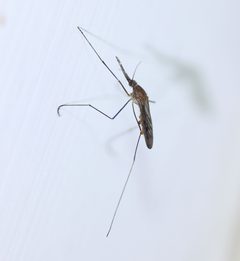
Anopheles walkeri is a North American mosquito found predominantly throughout the Mississippi River Valley, ranging north to southern Quebec, Canada. It is a freshwater swamp whose lack desiccation resistance, restricting it to permanently wet . The species exhibits distinctive activity patterns, with peak blood-feeding occurring late at night. A. walkeri has a multivoltine with specialized eggs that have enlarged floats, allowing it to complete one full larval before hibernating of other species become active. Despite occasional detection of human in southern U.S. specimens, it is considered an unlikely due to habitat preferences and low virus detection rates.
Pronunciation
How to pronounce Anopheles walkeri: //əˈnɒfɪliːz ˈwɔːlkəraɪ//
These audio files are automatically generated. While they are not always 100% accurate, they are a good starting point.
Identification
Anopheles walkeri can be distinguished from other North American Anopheles by its strong association with permanent freshwater swamps and its distinctive . Its multivoltine produces active in early spring during open water conditions, unlike many sympatric Anopheles that emerge later. The species' have enlarged floats compared to summer eggs, a morphological for . Adults are active later in the evening than most co-occurring mosquito species, with peak feeding activity occurring late at night. In Iowa long-term studies, A. walkeri was among the less abundant Anopheles species captured, suggesting it may be underrepresented in standard trapping methods.
Images
Habitat
Freshwater swamp with permanent standing water. The is restricted to swampy regions where water is consistently available throughout the year, as its are not to desiccation. Eggs are laid directly on the water surface.
Distribution
Predominantly throughout the Mississippi River Valley, ranging as far north as southern Quebec, Canada. GBIF records indicate presence in Middle America, North America, and Vermont, USA. The Iowa State University long-term study (2004-2023) documented it among six Anopheles in that state, though it was much less abundant than Anopheles punctipennis and Anopheles quadrimaculatus.
Seasonality
Multivoltine with activity during both early spring open water conditions and later in the year after swampland has become thickened with plant growth. become active later in the evening than most other mosquito in their range, with peak blood-feeding activity occurring late at night. In Iowa studies, abundance patterns showed species-specific dynamics distinct from co-occurring Anopheles punctipennis and Anopheles quadrimaculatus.
Diet
females seek blood meals late at night to obtain protein for development. Both sexes feed on nectar; Anopheles generally show preferences for daisies (Asteraceae), legumes (Fabaceae), and euphorbias (Euphorbiaceae), though specific nectar preferences for A. walkeri have not been documented.
Life Cycle
Multivoltine with approximately 10 days required to mature through larval stages and pupate, dependent on temperature and water conditions. Produces distinct morphs: hardy winter eggs with enlarged floats versus more vulnerable summer eggs. occurs in egg form, allowing the to complete one full larval before hibernating of other species become active. Adults typically mate within hours of . Females seek blood meals, rest during egg development, oviposit, and repeat the cycle for approximately 40 days.
Behavior
activity pattern with later evening onset than most sympatric mosquito . Feeding activity is strongly affected by microclimate conditions: wind, low humidity, and cool temperatures (around 10°C or below) negatively correlate with feeding aggression. Females oviposit directly on water surfaces in permanent swamps.
Ecological Role
Member of freshwater swamp aquatic . Larvae contribute to aquatic ; serve as prey for various . The ' early spring may provide a temporal separation from other Anopheles species.
Human Relevance
Considered an unlikely of West Nile virus to humans due to preferences and low rates of virus detection. Specimens in the southern United States have been found to harbor human (Plasmodium vivax and P. falciparum), albeit infrequently (frequency <0.005), but the has not been shown to transmit . Its restriction to swamp habitats limits human contact compared to more mosquitoes. The species was among six Anopheles documented in Iowa's 20-year mosquito surveillance study, which serves as a template for understanding malaria vector in North America.
Similar Taxa
- Anopheles quadrimaculatusBoth are North American Anopheles , but A. quadrimaculatus was far more abundant in Iowa trapping studies and shows different seasonal dynamics, emerging more slowly and peaking before summer's end.
- Anopheles punctipennisCo-occurs in eastern North America, but A. punctipennis emerges earlier in the season, steadily increases throughout, and shows positive correlation with precipitation and forest cover, unlike the swamp- A. walkeri.
- Anopheles earleiBoth found in Iowa studies, but A. earlei was the only collected Anopheles not considered a , whereas A. walkeri has documented associations with Plasmodium .
More Details
Research significance
The 20-year Iowa State University study (2004-2023) that documented A. walkeri among six state Anopheles serves as a template for other states to understand , particularly relevant given 2023's first locally transmitted U.S. malaria cases in two decades.
Egg morphology
Winter differ morphologically from summer eggs by having enlarged floats on the side, an that facilitates survival in permanent swamp .
Sources and further reading
- BugGuide
- Wikipedia
- GBIF taxonomy match
- iNaturalist taxon
- NCBI Taxonomy
- Catalogue of Life
- Anthony Cornel Knows Mosquitoes | Bug Squad
- Anopheles Mosquitoes as Vectors of Malaria in East Africa: Bed Nets and Beyond
- How One State's Mosquito Data Could Reduce Risk of Malaria Returning to U.S.
- Cannibalism in Mosquito Larvae Confounds Egg Counts
- The Sweetest Snack: Research Details Mosquitoes' Nectar Preferences
- Inducing Mosquitoes to Lay Eggs Aids in Insecticide Resistance Testing
- Studies on the Biology of Anopheles walkeri Theobald (Diptera: Culicidae)