
Anopheles punctipennis
Say, 1823
Woodland Malaria Mosquito
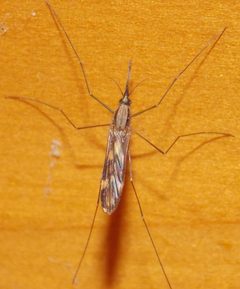
Anopheles punctipennis, commonly called the woodland mosquito, is a mosquito native to North America and distributed throughout the continent. It is capable of transmitting human malaria Plasmodium vivax and P. falciparum, though experimental studies suggest it is a relatively poor for P. falciparum with limited parasite development. The species is also involved in transmission of Plasmodium odocoilei, a malaria parasite of ungulates. In addition to malaria, it has been implicated as a potential bridge for virus and other .


Pronunciation
How to pronounce Anopheles punctipennis: /əˈnɒfɪˌliːz ˌpʌŋktɪˈpɛnɪs/
These audio files are automatically generated. While they are not always 100% accurate, they are a good starting point.
Identification
Anopheles punctipennis can be distinguished from other North American Anopheles through molecular diagnostic tools targeting the Internal Transcribed Spacer 2 (ITS2) region of ribosomal , which shows consistent sequence length and no intragenomic variation across its range. It is closely related to other members of the Maculipennis group. The species shows ecological differences from sympatric Anopheles quadrimaculatus: An. punctipennis emerges earlier in the season and shows steadily increasing abundance through late summer, while An. quadrimaculatus emerges more slowly and peaks earlier. Forest cover promotes abundance of An. punctipennis, consistent with its .
Images
Habitat
Larvae develop in cool, clear waters including streams and various natural and artificial water bodies. are generally found outdoors and rarely enter dwellings. The occurs in urban, rural, and forest settings.
Distribution
Native to and found throughout North America; present in the Caribbean, Middle America, North America, and South America according to distribution records. Documented in the eastern and midwestern United States including Vermont, New York, New Jersey, Iowa, and Tennessee.
Seasonality
Emerges earlier in the season than sympatric Anopheles , with abundance steadily increasing throughout the season and peaking in late summer. Early fall brings a sharp drop in numbers.
Diet
Females feed on blood, including human blood, and may bite during the day or night. Blood meal analysis shows predominantly mammalian , with white-tailed deer (Odocoileus virginianus) constituting the most common vertebrate host (85.8–97.7% of identified bloodmeals). Occasional avian-derived bloodmeals detected from mourning dove, sharp-shinned hawk, and house finch, mostly in mixed bloodmeals. Males and females feed on nectar and honeydew.
Host Associations
- Homo sapiens - blood
- Odocoileus virginianus - primary blood 85.8–97.7% of bloodmeals identified
- Cardinalis cardinalis - blood identified in Tennessee zoo study
- Zenaida macroura - occasional blood
- Accipiter striatus - occasional blood
- Carpodacus mexicanus - occasional blood
- Plasmodium vivax - transmittedhuman
- Plasmodium falciparum - transmittedhuman ; experimental studies show poor competence
- Plasmodium odocoilei - transmittedungulate
- Eastern equine encephalitis virus - potential transmittedisolate recovered from mosquito and in New York
Life Cycle
Larvae develop in aquatic . Oviposition occurs in water; females do not appear to avoid laying in water where larvae are present. Third- and fourth-instar larvae exhibit on eggs and first-instar larvae of their own .
Behavior
Females may bite during the day or night. generally stay outdoors and are rarely found inside dwellings. Shows earlier seasonal compared to sympatric Anopheles quadrimaculatus.
Ecological Role
Serves as a for and potentially other . Acts as a blood-feeding parasite on mammals and birds. Larval stages occupy aquatic .
Human Relevance
of human Plasmodium vivax and P. falciparum, though appears to be a relatively poor for P. falciparum based on experimental studies. Potential bridge vector for virus from birds to mammals including horses and humans. Subject to mosquito control efforts; resistance to organochlorine has been documented, though not associated with kdr mutation.
Similar Taxa
- Anopheles quadrimaculatusSympatric North American ; differs in seasonal (An. quadrimaculatus emerges more slowly and peaks earlier than An. punctipennis) and shows different abundance patterns in response to precipitation
- Anopheles gambiaeMajor African ; not sympatric but both are members of Anopheles with similar medical importance
- Anopheles maculipennis complexFormerly included An. punctipennis; molecular data confirm An. punctipennis as distinct within Maculipennis group
Sources and further reading
- BugGuide
- Wikipedia
- GBIF taxonomy match
- iNaturalist taxon
- NCBI Taxonomy
- Catalogue of Life
- How One State's Mosquito Data Could Reduce Risk of Malaria Returning to U.S.
- Folklore and Myth: The Invertebrate Edition - Buglife Blog - Buglife
- Even at the Zoo, Mosquitoes Favor Local Wild Birds for Meals
- Anopheles Mosquitoes as Vectors of Malaria in East Africa: Bed Nets and Beyond
- Cannibalism in Mosquito Larvae Confounds Egg Counts
- The Sweetest Snack: Research Details Mosquitoes' Nectar Preferences
- Anopheles Punctipennis, a Host of Tertian Malaria
- Knockdown Resistance (kdr) Associated Organochlorine Resistance in Mosquito-Borne Diseases (Anopheles albimanus, Anopheles darlingi, Anopheles dirus and Anopheles punctipennis): A Systematic Review Study
- Anopheles Punctipennis: A Note on Its Ability to Serve as a Host for Plasmodium Falciparum
- Notes on the Life History of Anopheles punctipennis and on the Egg-Laying of Culex pipiens
- Identification of bloodmeals in Anopheles quadrimaculatus and Anopheles punctipennis from eastern equine encephalitis virus foci in northeastern U.S.A.
- The New Internal Transcribed Spacer 2 Diagnostic Tool Clarifies the Taxonomic Position and Geographic Distribution of the North American Malaria Vector Anopheles Punctipennis