
Anopheles quadrimaculatus
Say, 1824
common malaria mosquito
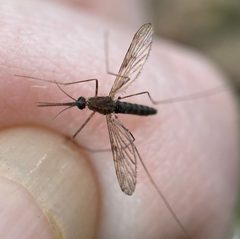
Anopheles quadrimaculatus is a mosquito historically recognized as the most important in the eastern United States. It belongs to a complex that includes at least four genetically distinct forms. The species breeds in freshwater , particularly intermittently flooded swamps and rice fields. While it remains capable of transmitting Plasmodium , local malaria transmission in its range has been eliminated through vector control and public health measures.
Pronunciation
How to pronounce Anopheles quadrimaculatus: /ænˈɒfɪliːz ˌkwɒdrɪmæˈkjuːlætəs/
These audio files are automatically generated. While they are not always 100% accurate, they are a good starting point.
Identification
Anopheles quadrimaculatus is part of a complex that includes A, B, C, and D, which are morphologically indistinguishable as . Molecular identification via amplification of rDNA ITS2 regions is required for definitive species assignment. Larvae lack breathing siphons and rest parallel to the water surface to breathe, a characteristic of the Anopheles.
Images
Habitat
Intermittently flooded swamps; rice fields; rice-growing regions. Larval are characterized by freshwater conditions with inorganic ions present. The has been documented in association with other Anopheles species, including Anopheles inundatus and Anopheles maverlius, at shared breeding sites.
Distribution
Eastern United States, with particular abundance in the southeastern region and along the Gulf Coast. Documented from Virginia, Maryland, North Carolina, central Florida, northern Florida, central New York State, southwestern Louisiana, and Arkansas. Distribution overlaps with Anopheles freeborni in some areas. Also present in the Caribbean and Middle America.
Host Associations
- Humans - blood primary blood among sympatric
- Plasmodium vivax - historically transmitted in eastern United States
- Plasmodium - general
- Dirofilaria immitis - susceptible laboratory susceptibility demonstrated
- Eastern equine encephalomyelitis virus - susceptible affected by virus in laboratory or field conditions
Life Cycle
are laid on still bodies of freshwater and float on the surface. Larvae hatch in 2 to 3 days. Larval development takes 5 days to 2 weeks depending on environmental conditions. typically live approximately 2 weeks. All stages (eggs, 1st through 4th instars, pupae) are identifiable via molecular methods.
Behavior
Larvae rest parallel to the water surface to breathe due to the absence of breathing siphons. Adapted to intermittently flooded swamp conditions.
Ecological Role
Historically the most important of in the eastern United States. Involved in local transmission of Plasmodium vivax in Virginia. Laboratory studies indicate susceptibility to Dirofilaria immitis and Eastern equine encephalomyelitis virus. Vector competence for Zika virus has been tested; laboratory experiments indicate inability to be infected with ZIKV, suggesting this is unlikely to be involved in Zika virus transmission in North America.
Human Relevance
Primary historical significance as a in the eastern United States. Malaria transmission by this has been eliminated through public health interventions, though the vector potential remains. Subject to surveillance and management programs in rice-growing regions.
Similar Taxa
- Anopheles freeborniOverlapping distribution in parts of the United States; both are North American Anopheles capable of transmission. Anopheles freeborni is the western malaria mosquito, whereas Anopheles quadrimaculatus occurs primarily in the eastern United States.
- Anopheles inundatusMember of the same complex; sympatric in Louisiana where both have been collected from shared or adjacent breeding sites. Requires molecular methods for differentiation.
- Anopheles maverliusMember of the same complex; collected in association with Anopheles quadrimaculatus at shared breeding sites in Louisiana. Morphologically indistinguishable; requires molecular identification.
- Anopheles smaragdinusMember of the same complex; not collected in some surveys where other complex members were present, suggesting possible or geographic separation within the complex.
More Details
Sibling Species Complex
Anopheles quadrimaculatus comprises at least four genetically distinct (A, B, C, and D) that cannot be distinguished by morphological characteristics. A validated method using rDNA ITS2 differences provides 100% specificity and 95% sensitivity for identification.
Colonization Difficulties
Attempts to colonize four from the complex in laboratory conditions have failed, limiting detailed experimental study of and competence.
Wolbachia Status
pipientis, a bacterial endosymbiont present in many arthropods, was not detected in 62 tested mosquitoes from this complex in one study.
Sources and further reading
- BugGuide
- Wikipedia
- GBIF taxonomy match
- iNaturalist taxon
- NCBI Taxonomy
- Catalogue of Life
- Mosquitoes, Malaria and the Civil War | Bug Squad
- An Eyewitness to the Fall of Saigon and a Glance at Mosquitoes and Malaria | Bug Squad
- Malaria, Memorial Day and Memories of the Civil War | Bug Squad
- Mosquito Expert Julián Hillyer's Topic: 'Not So Heartless!' | Bug Squad
- Mosquito Researcher to Discuss His Work on Immune Cells | Bug Squad
- Observing Bay Area World Malaria Day | Bug Squad
- Biology and Ecology of the Anopheles Quadrimaculatus Sibling Species Complex in Louisiana.
- Figure 1: USA distribution by state of Anopheles freeborni, Anopheles quadrimaculatus, and Culex tarsalis (Hayes et al., 2005; Venkatesan & Rasgon, 2010; Manguin, 2013).
- Common malaria Mosquito Anopheles quadrimaculatus Say (Insecta: Diptera: Culicidea)
- Behavior of Microfilariae of Brugia Pahangi in Anopheles Quadrimaculatus