
Anopheles freeborni
Aitken, 1939
western malaria mosquito
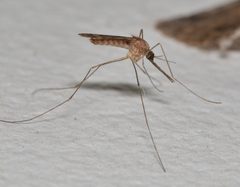
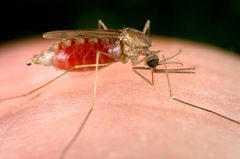
Anopheles freeborni is a medium-sized mosquito native to western North America, historically recognized as the primary in the western United States. are distinguished by four dark wing spots and gray-brown thoracic stripes. The species exhibits strong zoophilic feeding preferences, primarily targeting cattle, horses, and other large mammals, though human blood meals occur at lower frequencies. Larval development occurs in stagnant freshwater , particularly rice fields and associated irrigation systems. Females overwinter in sheltered locations and exhibit prehibernation of up to 28 km. Mating occurs in large evening swarms from July through September.
Pronunciation
How to pronounce Anopheles freeborni: //əˈnɒfɪliːz friːˈbɔːrni//
These audio files are automatically generated. While they are not always 100% accurate, they are a good starting point.
Identification
Distinguished from by four dark wing spots and unique tapered on the media and radial sector of wing undersides. Most similar to Anopheles hermsi, with which it shares phylogenetic affinity and morphological features; recent studies suggest historical misidentifications between these in Colorado and Arizona. Gray-brown thoracic stripes and yellow-brown body hairs aid field identification. Males distinguished by less distinct wing spots and participation in evening swarms.
Images
Habitat
Larval include stagnant freshwater: rice fields, roadside pools, groundwater sources, and algal masses. Vegetative cover strongly preferred for oviposition sites; shallow, still, partially sunlit water with or other vegetation favored. occupy cool, shaded daytime resting sites including drainage tunnels, dark corners of structures, beneath bridges, and wood rat nests. Females overwinter in human structures including basements, houses, garages, and barns, moving between shelters rather than remaining stationary.
Distribution
Western North America, predominantly west of the Rocky Mountains. Core range includes western United States and British Columbia, Canada. Most abundant in California, particularly San Joaquin and Sacramento valleys. Peripheral records from Texas, New Mexico, and southern Colorado. Observed in Mexico. Distribution overlaps with Anopheles quadrimaculatus in some areas.
Seasonality
Active primarily during warmer months. Prehibernation occur in September. Females overwinter and return to larval in February for spring oviposition. Mating swarms occur July through September. Gonotrophic cycle length 4-6 days depending on feeding status.
Diet
Larvae feed on microorganisms including at water surface, using oral brushes to generate spiraling currents. are obligate blood feeders with strong zoophilic preference: cattle (46.3% of blood meals), horses (24.6%), dogs (10.4%), humans (7.8%), and other mammals including chickens, pigs, sheep, goats, cats, rabbits, and deer. Feeding primarily occurs during and after dusk; daytime feeding observed during overcast conditions. Females enter dwellings to obtain blood meals.
Host Associations
- Bos taurus - blood primary , 46.3% of blood meals
- Equus caballus - blood 24.6% of blood meals
- Canis lupus familiaris - blood 10.4% of blood meals
- Homo sapiens - blood 7.8% of blood meals; seasonal variation with higher rates May-June
- Gallus gallus domesticus - blood 5.2% of blood meals
- Leporidae - blood frequently observed feeding on rabbits
- Odocoileus - blood deer documented as
- Ovis aries - blood sheep documented as
- Neotoma - hibernation site observed in wood rat nests
Life Cycle
Complete with four stages: , larva, pupa, . Total development approximately 20 days. Eggs deposited directly into still water, floating at surface; hatch in 2-3 days or several weeks depending on temperature. Larvae aquatic, positioned horizontally beneath water surface; possess abdominal for breathing. Four larval instars over approximately 15 days, followed by . Pupae non-feeding with formed from and ; respiratory openings at surface. Adults emerge from ruptured cephalothorax after several days, resting on water surface before .
Behavior
Males form evening mating swarms from July through September, initiated at light intensities of approximately 350 lux and ending at 0.5 lux. Swarms reach 500-3000 individuals and persist up to 35 minutes; smaller males initiate swarms to reduce competition. Females join at peak with copulation occurring 10-20 minutes after swarm formation. Prehibernation in September commonly 8-16 km, with maximum recorded distance 28 km. During , females move between multiple shelters rather than remaining in fixed locations. -seeking females exhibit stronger flight activity than swarm-mating females.
Ecological Role
Primary historical for (Plasmodium spp.) in western United States semiarid and arid regions. Involved in late 19th and early 20th century malaria in northern California. Acts as potential bridge vector between animal and humans despite zoophilic preferences. Larval stage serves as prey for larvae, frogs, spiders, and flatworms. swarms subject to by dragonflies (Erythemis collocata, Pantala hymenaea), with highest predation risk during first 15 minutes of swarm formation.
Human Relevance
Historically the principal in the western United States, responsible for significant in northern California during 1890s-1900s. Current public health significance debated due to morphological similarity with Anopheles hermsi and questions about relative vector importance. Subject to control efforts including (Bacillus thuringiensis, piperidine compounds, CIC-4 lactone) and using mosquitofish (Gambusia affinis) in rice fields. Named for Stanley Barron Freeborn (1891-1960), first UC Davis chancellor and malariology authority.
Similar Taxa
- Anopheles hermsiMost closely related ; phylogenetically sister species in Freeborni subgroup; morphologically similar with historical misidentification issues in Colorado and Arizona
- Anopheles quadrimaculatusOverlapping distribution in some areas; both implicated in transmission; distinguished by wing spot patterns and thoracic markings
- Anopheles occidentalisMember of same Freeborni subgroup; similar western North American distribution
- Anopheles earleiMember of same Freeborni subgroup; similar associations
Misconceptions
Historical assumption that reduced counts at oviposition sites indicated female avoidance of larval presence; this pattern may actually reflect by older larvae rather than oviposition deterrence. Recent studies have questioned the significance of A. freeborni as a relative to A. hermsi due to past misidentifications.
More Details
Multiple mating
Multiple paternity occurs at low frequency in field (observed in 1 of 36 examined, 2.8%); attributed to incomplete sperm or male accessory gland substance transfer rather than female receptivity renewal
Vector competence
Laboratory studies demonstrate inability to be infected with Zika virus; considered unlikely ZIKV in North America
Host feeding variation
Human blood index varies seasonally, with higher rates in early season (May-June) declining by late season; selection influenced by availability, human activity, and housing quality
Sources and further reading
- BugGuide
- Wikipedia
- GBIF taxonomy match
- iNaturalist taxon
- NCBI Taxonomy
- Mosquitoes, Malaria and the Civil War | Bug Squad
- A Story No One Is Letting Robert Washino Forget | Bug Squad
- William Hazeltine II: His Passion, His Work Live On | Bug Squad
- Anopheles Mosquitoes as Vectors of Malaria in East Africa: Bed Nets and Beyond
- How One State's Mosquito Data Could Reduce Risk of Malaria Returning to U.S.
- Cannibalism in Mosquito Larvae Confounds Egg Counts
- Identification And Monitoring Of Anopheles Freeborni Habitats In Northern California
- Figure 1: USA distribution by state of Anopheles freeborni, Anopheles quadrimaculatus, and Culex tarsalis (Hayes et al., 2005; Venkatesan & Rasgon, 2010; Manguin, 2013).
- Host-Feeding Patterns of Anopheles Freeborni in the Sacramento Valley, California1
- Ecology of a Semi-Isolated Population of Adult Anopheles Freeborni: Abundance, Trophic Status, Parity, Survivorship, Gonotrophic Cycle Length, and Host Selection
- Multiple mating in female mosquitoes—evidence from a field population of Anopheles freeborni (Diptera: Culicidae)
- Blood feeding patterns ofAnopheles freeborniandCulex tarsalis(Diptera: Culicidae): effects of habitat and host abundance
- 4-(1 H )-Quinolones and 1,2,3,4-Tetrahydroacridin-9(10 H )-Ones Prevent the Transmission of Plasmodium falciparum to Anopheles freeborni