
Caryomyia turbanella
Gagné, 2008
Caryomyia turbanella is a of gall midge in the Cecidomyiidae, described by Gagné in 2008. It belongs to a whose members are known for inducing galls on hickory and pecan trees (Carya spp.). The species name 'turbanella' refers to the distinctive turban-shaped galls it produces on leaves.
Pronunciation
How to pronounce Caryomyia turbanella: /ˌkɛərioʊˈmaɪə tɜːrˈbænɛlə/
These audio files are automatically generated. While they are not always 100% accurate, they are a good starting point.
Identification
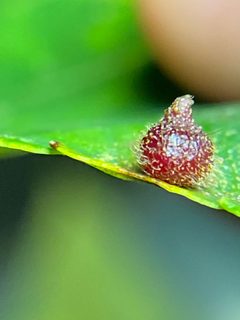
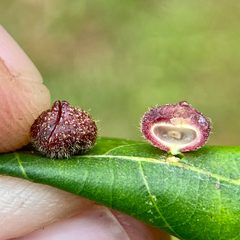
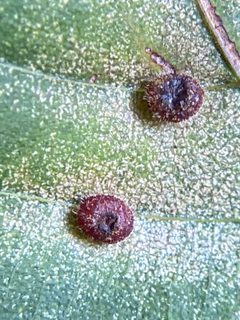
Distinguished from other Caryomyia by the turban-shaped of its galls on hickory leaves. The galls are disc-shaped with a raised central cone, resembling a turban or spindle . are small (2-3 mm), delicate flies with long, beaded characteristic of the ; specific adult diagnostic features for C. turbanella require microscopic examination.
Images
Habitat
Deciduous forests and woodlands where hickory (Carya) trees occur. Found in areas with mature hickory stands, including bottomland forests, upland hardwood forests, and suburban landscapes with native tree cover.
Distribution
Eastern North America, where hickory (Carya) are native. Documented from the United States; precise range limits require further survey.
Seasonality
occurs in spring, coinciding with hickory leaf flush. Galls are visible on leaves from late spring through summer, with mature galls persisting on fallen leaves into autumn.
Host Associations
- Carya - gall induction plant for gall formation; specific hickory not definitively documented
Behavior
Larvae develop within leaf galls, feeding on plant tissue. The gall provides protection and nutrition for the developing larva. occurs within the gall or in soil.
Ecological Role
As a gall inducer, modifies plant tissue to create a microhabitat for its own development. Serves as a food source for and other natural enemies. Galls may slightly reduce photosynthetic area but generally cause minimal harm to healthy host trees.
Human Relevance
Of minor economic concern; galls are primarily a curiosity and do not significantly impact hickory or pecan timber or nut production. May be encountered by naturalists and entomologists studying gall-forming insects.
Similar Taxa
- Caryomyia caryaecolaAlso forms galls on hickory, but produces smooth, spherical or oval galls rather than turban-shaped structures
- Caryomyia tubicolaForms tubular or finger-like galls on hickory leaf , distinct from the disc-shaped turban gall
- Other Cecidomyiidae on CaryaMultiple induce galls on hickory; Caryomyia are distinguished by gall and larval chamber structure
More Details
Gall morphology
The turban gall is a hypophyllous (lower surface) leaf gall, typically 3-6 mm in diameter, with a conical or nipple-like projection rising from a circular base. The gall is usually green when young, becoming brown with age.