
Caryomyia supina
Hickory Supine Squash Gall Midge
A gall midge in the Cecidomyiidae that induces distinctive galls on hickory leaves. The is associated with Carya species, particularly shagbark hickory (Carya ovata). are small, delicate flies typical of the family. The specific epithet 'supina' refers to the supine (upward-facing) orientation of the gall structure.
Pronunciation
How to pronounce Caryomyia supina: //ˌkær.i.oʊˈmaɪ.ə suːˈpaɪ.nə//
These audio files are automatically generated. While they are not always 100% accurate, they are a good starting point.
Identification
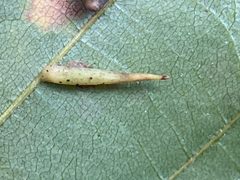
Galls appear as small, pouch-like or bladder-like structures on the upper surface of hickory leaves, often with a slit-like opening. The galls are typically pale green to yellowish, becoming more conspicuous as they mature. The supine orientation—lying flat or upward-facing on the leaf surface—distinguishes this from related Caryomyia species that produce different gall morphologies. are minute, fragile flies with reduced wing venation and long, bead-like characteristic of Cecidomyiidae.
Images
Habitat
Deciduous forests and woodlands containing hickory trees, particularly shagbark hickory. Occurs in temperate eastern North American forest where trees are present.
Distribution
Eastern North America, ranging from the northeastern United States through the Midwest, following the distribution of its primary hickory .
Seasonality
and gall formation occur in spring coinciding with hickory leaf flush; galls visible on leaves through summer; adults likely overwinter in soil or leaf litter.
Host Associations
- Carya ovata - gall inductionPrimary ; induces leaf galls on shagbark hickory
Ecological Role
Gall induction creates localized nutrient sinks on hickory leaves; galls may provide microhabitats for and within the gall .
Human Relevance
Of minor economic significance; galls cause minimal damage to hickory trees and do not affect timber or nut production substantially. Occasionally noted by naturalists and entomologists studying gall-forming insects.
Similar Taxa
- Caryomyia caryaecolaAlso induces galls on hickory leaves, but produces elongate, tongue-shaped or horn-like galls rather than the supine, pouch-like galls of C. supina
- Caryomyia tubicolaForms tubular or spindle-shaped galls on hickory petioles and midribs, differing in both location and from the leaf-blade galls of C. supina
- Other Caryomyia speciesApproximately 20 in the , most -specific to Carya; gall and location on the plant are primary distinguishing features