
Ampelomyia
Elsayed & Tokuda, 2019
Species Guides
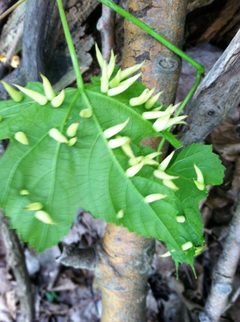
3- Ampelomyia viticola(grape tube gallmaker)
- Ampelomyia vitiscoryloides(grape filbert gall midge)
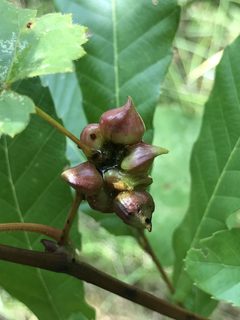
- Ampelomyia vitispomum
Ampelomyia is a of gall midges in the tribe Asphondyliini (Diptera: Cecidomyiidae), erected in 2019 to accommodate that induce galls on grape plants (Vitis). The genus contains four species: A. conicocoricis from Japan, and three Nearctic species transferred from other genera (A. viticola, A. vitiscoryloides, and A. vitispomum). All species are specialized gall inducers on Vitis species.
Pronunciation
How to pronounce Ampelomyia: /æmˌpɛloʊˈmaɪə/
These audio files are automatically generated. While they are not always 100% accurate, they are a good starting point.
Identification
can be distinguished from other Schizomyiina by the presence of a ventroapical extension on tarsomere I. Larvae are characterized by abdominal segment VIII bearing a posterodorsal lobe and a dorsally shifted pair of papillae. These morphological features, combined with molecular phylogenetic analysis, support the generic distinction.
Images
Habitat
Found in association with Vitis (grape) , forming leaf galls on both wild and cultivated grapes. In Japan, documented on cultivated Vitis coignetiae cultivar Suzumi-murasaki and wild V. coignetiae, V. flexuosa, and V. ficifolia in northern Japan.
Distribution
Palaearctic and Nearctic regions. The type A. conicocoricis occurs in northern Japan. The other three species (A. viticola, A. vitiscoryloides, A. vitispomum) are distributed in the Nearctic region, with records from the United States including Vermont.
Host Associations
- Vitis coignetiae - gall induction on leavesboth cultivated (cultivar Suzumi-murasaki) and wild forms
- Vitis flexuosa - gall induction on leaveswild in northern Japan
- Vitis ficifolia - gall induction on leaveswild in northern Japan
- Vitis - gall induction-level association for all four Ampelomyia ; specific data not detailed for Nearctic species
Behavior
Induces conical leaf galls on Vitis plants. Gall formation was previously misidentified as Schizomyia viticola based on gall shape alone, indicating that gall can be convergent and unreliable for identification without accompanying morphological or molecular analysis.
Ecological Role
Gall inducer on Vitis . Creates specialized plant structures that provide and nutrition for developing larvae, potentially affecting leaf function in grape plants.
Human Relevance
Associated with cultivated grape varieties (Vitis coignetiae), which may have implications for viticulture, though specific economic impact has not been documented. The was described in part from specimens collected from cultivated plants in Japan.
Similar Taxa
- Schizomyia viticolaPreviously misidentified as this based on similar conical gall shape; distinguished by larval and morphological characters and molecular
- Other Schizomyiina generaDistinguished by the combination of ventroapical extension on tarsomere I in , and larval features including posterodorsal lobe on abdominal segment VIII and dorsally shifted papillae
Misconceptions
Gall shape alone is insufficient for identification; A. conicocoricis was previously misidentified as Schizomyia viticola based on the conical shape of its leaf galls, demonstrating that morphological convergence in gall structure can lead to taxonomic errors without detailed examination of insect .
More Details
Taxonomic history
The was erected in 2019 by Elsayed and Tokuda based on morphological studies of larvae and from Japan, with molecular phylogenetic analysis supporting the taxonomic treatment. Three Nearctic were transferred to this genus as new combinations.
Gall morphology
Induces conical leaf galls, though this shape is not unique to the and has led to previous misidentification.