
Ampelomyia viticola
(Osten Sacken, 1862)
grape tube gallmaker, grape-leaf trumpet-gall, conical grape gall
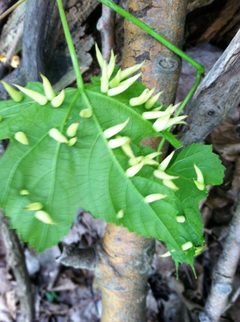
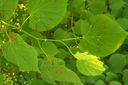
Ampelomyia viticola is a gall midge that induces distinctive tubular galls on grape vine leaves in eastern North America. The galls are narrow, conical structures measuring 7–10 mm long, typically crimson in color though green when young or on leaf undersides. Each gall contains a single larval chamber housing one pale yellowish-green to orange larva. The was transferred from Schizomyia to the new Ampelomyia in 2019.
Pronunciation
How to pronounce Ampelomyia viticola: /ˌæm.pəˈloʊ.miˌaɪ.ə ˈvɪt.ɪˌkoʊ.lə/
These audio files are automatically generated. While they are not always 100% accurate, they are a good starting point.
Identification
Distinguished from other grape gall makers by the narrow, conical, sometimes slightly curved tubular shape of its galls. The galls are typically crimson (occasionally green), located on upper leaf surfaces, and contain a single smooth-walled chamber. The specific epithet viticola and association with Vitis helps distinguish it from Ampelomyia species on other plants. Previously placed in Schizomyia, separation from congeneric species requires examination of larval , particularly the bilobed extremity with prehensile processes and distinctive spot pattern.
Images
Habitat
Found in supporting native grape vines, including riparian corridors, woodland edges, and disturbed areas. Galls occur on leaves of wild grape . Rare in cultivated vineyards.
Distribution
Eastern Nearctic region: eastern United States and southeastern Canada (Ontario). Type locality: environs of Washington, D.C. Documented in multiple eastern states. Reports from Japan are misidentifications.
Seasonality
Galls present July through August, with records extending to early September (September 8).
Diet
Larvae feed on tissue within grape leaf galls; specific feeding mechanism inducing gall formation not described.
Host Associations
- Vitis riparia - gall wild grape
- Vitis labrusca - gall fox grape
- Vitis vulpina - gall frost grape
- Vitis aestivalis var. bicolor - gall summer grape variety
Life Cycle
Developmental stages include , larva, pupa, and . Larvae develop singly within galls. Specific details of egg deposition, site, and number of per year not documented.
Behavior
Larval development occurs within individual chambers inside leaf galls. Up to 75–135 galls may occur on a single leaf. Galls typically form on upper leaf surfaces.
Ecological Role
Forms phytophagous associations with native Vitis . Galls represent minor plant damage with limited ecological impact; usually sparse even where present.
Human Relevance
Not considered economically significant to viticulture; galls are rare in vineyards and not particularly harmful to wild plants. Subject of historical taxonomic interest due to complex nomenclatural history involving Osten-Sacken, Walsh, and Riley.
Similar Taxa
- Other Schizomyia/Ampelomyia speciesSimilar gall ; distinguished by plant association and larval morphological details
- Other grape-inhabiting CecidomyiidaeDifferent gall shapes; A. viticola specifically produces narrow tubular/conical galls with single chamber
Misconceptions
Historical reports of occurrence in Japan are erroneous and represent misidentifications of other .
More Details
Taxonomic history
Described by Osten-Sacken in 1862 as Cecidomyia viticola. Walsh and Riley proposed the unavailable name 'Cecidomyia vitis lituus' in 1869. Felt incorrectly referred to it as 'Cecidomyia lituus Walsh' in 1911. Transferred from Schizomyia to new Ampelomyia in 2019. The synonym lituus refers to a curved staff or trumpet, describing gall shape.
Gall density
Individual leaves may bear 75–135 galls, though overall in any given area is typically low.