
Asphondyliini
Genus Guides
6Asphondyliini is a tribe of gall midges within the Cecidomyiidae, comprising approximately six and at least 100 described . Members are distributed across multiple biogeographic regions including the Neotropics, Palearctic, and Oriental regions. The tribe is characterized by gall-inducing on diverse plants, with documented associations across numerous angiosperm families including Fabaceae, Malpighiaceae, Lauraceae, and Verbenaceae. Several genera within the tribe have been subject to recent taxonomic revision based on phylogenetic analyses.
Pronunciation
How to pronounce Asphondyliini: /æsˌfɒndɪˈlaɪənaɪ/
These audio files are automatically generated. While they are not always 100% accurate, they are a good starting point.
Identification
Asphondyliini can be distinguished from other Cecidomyiidae tribes primarily through larval and morphological characters. Schizomyia, a representative , is characterized by a needlelike ovipositor, four-segmented palpi, and larvae with all four pairs of terminal papillae present. Bruggmanniella is recognizable by the gonostylus shape, which is equally subdivided into toothed and setose portions. Generic-level identification requires examination of pupal spiracular horns, larval terminal papillae, and adult genitalic structures.
Images
Habitat
occur in diverse including restinga vegetation of the Atlantic Forest in Brazil, forested areas in Japan, and montane regions in Taiwan. Specific microhabitats are defined by plant distribution.
Distribution
Widely distributed across biogeographic regions: Neotropical (Brazil, El Salvador), Palearctic (Japan), and Oriental (Taiwan). In Brazil, documented from multiple states including Rio de Janeiro, São Paulo, and Espírito Santo.
Host Associations
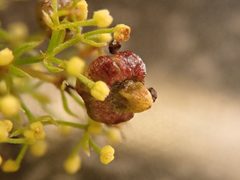
- Tetrapterys phlomoides - gall inductionrosette bud galls; first record of Schizomyia on Malpighiaceae
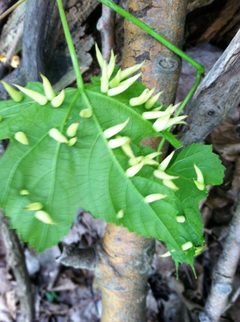
- Litsea acuminata - gall inductioncup-shaped and umbrella-shaped leaf galls
- Struthanthus acuminatus - gall induction of Asphondylia braziliensis
- Erythroxylum ovalifolium - gall induction Atlantic Forest of Asphondylia fluminensis
- Lantana fucata - gall induction of Asphondylia marambaiensis
- Varronia curassavica - gall induction of Asphondylia varroniae
- Heliotropium sp. - gall induction of Asphondylia xerezi
- Swartzia langsdorffii - gall inductionleaf galls; of Burseramyia braziliensis
- Bauhinia brevipes - gall inductionleaf galls; of Asphondylia microcapillata and Schizomyia macrocapillata
- Doliocarpus dentatus - gall induction of Bruggmanniella
- Cordia sp. - gall induction of Asphondylia cordiae
- Byrsonima sp. - gall induction of Bruggmanniella byrsonimae
Life Cycle
Larvae develop within plant galls induced by females using protusible needlelike ovipositors. occurs within galls; adults emerge from galls. Specific developmental details vary by .
Behavior
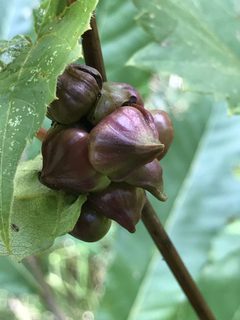
females induce distinct gall morphologies on plants through oviposition and subsequent larval activity. Gall shapes include rosette bud galls, cup-shaped leaf galls, umbrella-shaped leaf galls, and cylindrical structures. Some exhibit gall , with a single species inducing multiple gall on the same host plant.
Ecological Role
Primary gall inducers that manipulate plant tissue to form protective larval chambers. Serve as hosts for , particularly Braconidae (Bracon asphondyliae, B. sunosei, B. tamabae, Simplicibracon curticaudis, Testudobracon longicaudis, T. pleuralis documented from Japanese Asphondyliini).
Similar Taxa
- CecidomyiiniBoth tribes contain gall-inducing ; Asphondyliini distinguished by specific larval and morphological characters including ovipositor structure and pupal spiracular horn
- Other Cecidomyiidae tribesAsphondyliini share needlelike ovipositors and specific terminal papillae arrangements that differ from other tribes; phylogenetic analyses support monophyly of the tribe
Sources and further reading
- BugGuide
- Wikipedia
- iNaturalist taxon
- NCBI Taxonomy
- Catalogue of Life
- New geographic records of four species of Asphondyliini (Insecta, Diptera, Cecidomyiidae)
- A new species of Schizomyia (Diptera, Cecidomyiidae, Asphondyliini) associated with Tetrapterys phlomoides (Malpighiaceae)
- Host range of braconid species (Hymenoptera: Braconidae) that attack Asphondyliini (Diptera: Cecidomyiidae) in Japan
- Five new species of Asphondylia (Diptera, Cecidomyiidae, Asphondyliini) from Brazilian restinga (Atlantic Forest)
- Two new species of Asphondyliini (Diptera: Cecidomyiidae) associated with Bauhinia brevipes (Fabaceae) in Brazil
- Another step towards understanding evolutionary changes in Bruggmanniella Tavares, 1909 group (Diptera, Cecidomyiidae, Asphondyliini)
- A new species of Bruggmanniella (Diptera, Cecidomyiidae, Asphondyliini) associated with Doliocarpus dentatus (Dilleniaceae) in Brazil
- Burseramyia braziliensis, a new species of gall midge (Diptera, Cecidomyiidae, Asphondyliini) associated with Swartzia langsdorffii Raddi (Fabaceae)
- Two New and Three Known Japanese Species of Genus <I>Pseudasphondylia</I> Monzen (Diptera: Cecidomyiidae: Asphondyliini) and Their Life History Strategies
- Cladistic analysis of the genus Bruggmanniella Tavares (Diptera, Cecicomyiidae, Asphondyliini) with evolutionary inferences on the gall inducer-host plant association and description of a new Brazilian species
- Leaf gall polymorphism and molecular phylogeny of a new Bruggmanniella species (Diptera: Cecidomyiidae: Asphondyliini) associated with Litsea acuminata (Lauraceae) in Taiwan, with ecological comparisons and a species description