
Schizomyia
Kieffer, 1889
Species Guides
7- Schizomyia eupatoriflorae(Boneset Flower Gall Midge)
- Schizomyia impatientis(Jewelweed Gall Midge)
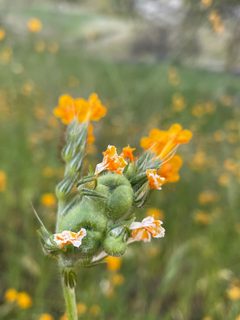
- Schizomyia macrofila(Fiddleneck Midge Gall)
- Schizomyia racemicola(Goldenrod Bunch Gall Midge)
- Schizomyia rivinae
- Schizomyia umbellicola(Elderberry Gall Midge)
- Schizomyia verbesinae
Schizomyia is a of gall midges (Diptera: Cecidomyiidae) with distribution. in this genus induce various types of galls on diverse plants, including rosette bud galls, inflorescence galls, and stem galls. The genus belongs to the tribe Asphondyliini and contains at least 51 described species. Some species have significant ecological and economic impacts, including that reduce seed production in forest trees and potential use as agents.
Pronunciation
How to pronounce Schizomyia: /ˌskɪzoʊˈmaɪə/
These audio files are automatically generated. While they are not always 100% accurate, they are a good starting point.
Images
Habitat
occur in diverse including coastal sandy plain vegetation (restinga), evergreen broad-leaved forests, arid Mediterranean coastal regions, and island . Specific habitat associations depend on plant distribution.
Distribution
distribution with records from North America (United States: Vermont), Europe (Denmark, Norway, Sweden), South America (Brazil), Africa (Egypt, Madagascar), the Middle East (Israel), and Asia (Japan, Korea). Some show island-specific distributions with documented range expansions.
Seasonality
Activity patterns vary by and climate. Schizomyia buboniae predominates from late winter to spring in Egypt. Schizomyia castanopsisae emerge in April in Japan, with developmental thresholds of 4.7°C (males) and 7.4°C (females).
Host Associations
- Tetrapterys phlomoides - gall inductionrosette bud galls (Malpighiaceae)
- Deverra triradiata - gall inductionbud galls (Apiaceae)
- Deverra tortuosa - gall inductionbarrel-shaped stem galls (Apiaceae)
- Castanopsis sieboldii - gall inductioninflorescence galls (Fagaceae)
- Bauhinia brevipes - gall inductionshoot galls (Fabaceae)
- Cryptostegia grandiflora - gall inductionleaf and bud galls (Apocynaceae)
Life Cycle
Larvae develop within plant galls; occurs inside the gall. Pupae of some possess characteristic features such as cephalic setae, prothoracic , and abdominal spines. emerge from pupal . Specific larval stages and detailed development are unknown for most species.
Behavior
Females possess needlelike ovipositors (1.15–1.4 mm in measured ) for inserting into plant buds or stems. Gall formation involves induction of characteristic structures: rosette bud galls with cylindrical bases, barrel-shaped stem galls, or inflorescence galls. Gall varies by species and host plant.
Ecological Role
Gall-forming insects that create distinct microhabitats on plants. Some significantly reduce reproductive output of host trees; Schizomyia castanopsisae reduces acorn production in Castanopsis sieboldii. Galls harbor associated including . can occur in the absence of natural enemies, with estimated larval populations reaching billions on affected islands.
Human Relevance
Some pose threats to forest through reduced seed production and potential dominance in evergreen forests. Schizomyia cryptostegiae has been evaluated as a agent for the weed Cryptostegia grandiflora (rubber vine) in Australia. Climate-based distribution modeling has been applied to predict suitability for management purposes.
More Details
Parasitoid associations
Schizomyia are attacked by including Inostemma spp. (Platygastridae) and Torymus hirtipennis (Torymidae). Parasitoid decreases with island distance from mainland and island area. Some island lack parasitoids entirely, contributing to dynamics.
Genetic structure and dispersal
Schizomyia castanopsisae in the Izu Islands and Okinawa share common haplotypes, distinct from Kyushu populations, suggesting recent invasion and northward range expansion. COI sequences show 99.8% identity between Japanese and Korean populations.
Gall characteristics and selection
Gall size and tissue thickness show evidence of directional selection from pressure. On islands with parasitoid Inostemma sp., larger galls with thicker tissues are favored; no directional selection detected where parasitoid pressure is absent.
Sources and further reading
- BugGuide
- Wikipedia
- GBIF taxonomy match
- iNaturalist taxon
- NCBI Taxonomy
- Catalogue of Life
- A new species of Schizomyia (Diptera, Cecidomyiidae, Asphondyliini) associated with Tetrapterys phlomoides (Malpighiaceae)
- Schizomyia botellus n.sp. – a new bud galling species from Apiaceae in Israel
- A New Species of Schizomyia Kieffer (Diptera: Cecidomyiidae) on Rubber Vine and Other Asclepiadaceae in Madagascar
- Figure 2: (A) Deverra tortuosa (Desf.) DC., (B) Gall shape of Schizomyia buboniae associated with Deverra tortuosa plant.
- Predicting the geographic distribution habitats of Schizomyia buboniae (Diptera: Cecidomyiidae) and its host plant Deverra tortuosa (Apiaceae) in Egypt by using MaxEnt modeling
- Mapping the Predicted Geographic Range of The Gall Former Schizomyia botellus (Diptera: Cecidomyiidae) under Influence of Climatic Factors in Arid Habitats.
- Long term oviposition preference and larval performance of Schizomyia macrocapillata (Diptera: Cecidomyiidae) on larger shoots of its host plant Bauhinia brevipes (Fabaceae)
- Community structure of parasitoids attacking Schizomyia sasakii (Diptera: Cecidomyiidae) and local adaptation of the gall midge in the Izu region
- Hundreds of billions of silent outbreaks: A historic outbreak record of the gall midge Schizomyia castanopsisae (Diptera: Cecidomyiidae) on the Izu Islands, Tokyo, Japan, and its potential mechanism
- Evergreen forests on the Korean Peninsula faced a new threat: Schizomyia castanopsisae (Jat-bam-na-mu-hok-pa-ri) inducing galls on reproductive organs of Castanopsis sieboldii in the Yokjido Island Natural Monument Forest
- Insights into the interactions between Deverra tortuosa and Schizomyia buboniae: phytochemicals, antioxidant capacity, and enzyme inhibitory effects.