
Coboldia fuscipes
(Meigen, 1830)
minute black scavenger fly, oyster mushroom fly
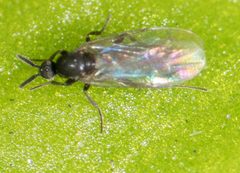
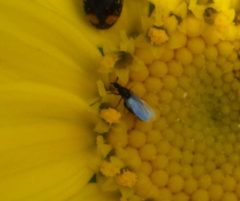
Coboldia fuscipes is a minute scatopsid fly, 2–3 mm in length, widely distributed across the Palearctic region. The is commonly associated with decomposing organic matter and has become a significant pest in oyster mushroom (Pleurotus ostreatus) , particularly in East Asia. are small, dark-colored flies often found on compost heaps and mushroom substrates. Temperature strongly influences its , with complete development possible in under 19 days at 28°C.
Pronunciation
How to pronounce Coboldia fuscipes: /kɔˈbɔldiə ˈfʊskɪpɛs/
These audio files are automatically generated. While they are not always 100% accurate, they are a good starting point.
Identification
Distinguished from other minute dark flies by -level characters of Scatopsidae: reduced wing venation with few crossveins, small size (2–3 mm), and association with decaying organic matter or mushroom substrates. May be confused with dark-winged fungus gnats (Sciaridae) or pomace flies (Drosophilidae), but scatopsids lack the prominent wing spots of some Drosophila and have distinct wing venation patterns. Antennal has been characterized for this species.
Images
Habitat
Decomposing organic matter including compost heaps; oyster mushroom environments and spawn substrates. Associated with decaying fungal, plant, or animal tissue.
Distribution
Palearctic region broadly; confirmed from Azores (Faial, Flores, Graciosa, Pico, São Miguel); Korea (documented as pest in mushroom ).
Diet
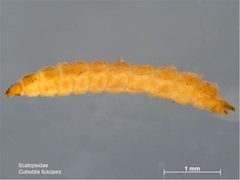
Larvae feed on mycelia of mushrooms and decaying fungal, plant, or animal tissue. Documented as causing serious damage to oyster mushroom (Pleurotus ostreatus) through larval feeding on spawn.
Host Associations
- Pleurotus ostreatus - larval food source / pestoyster mushroom; causes serious damage to
Life Cycle
Temperature-dependent development with quantified thermal thresholds. At 25°C: total lifespan approximately 24 days (males 24.5, females 24.1); at 28°C: under 19 days (males 18.9, females 17.9). Developmental zero: 11.6°C, larvae 11.5°C, pupae 8.8–9.2°C. Required heat units: 38 (eggs), 180 (larvae), 66–67 (pupae). Average : 282 eggs per female, laid in masses on spawn.
Behavior
observed on surfaces of compost piles and mushroom substrates. Females oviposit in masses on spawn. Recently emerged adults perch with wings uninflated, awaiting full wing expansion.
Ecological Role
Decomposer in natural , breaking down decaying organic matter. In agricultural contexts, acts as a pest causing serious economic damage to oyster mushroom .
Human Relevance
Significant pest of oyster mushroom in Korea and potentially elsewhere. Presence in compost heaps indicates active decomposition processes. No documented beneficial uses.
Similar Taxa
- Drosophila spp. (pomace flies)Similar small size and association with decaying matter; distinguished by wing venation, lack of prominent wing spots in C. fuscipes, and different -level characters
- Sciaridae (dark-winged fungus gnats)Similar size and dark coloration; slightly larger on average, with different wing venation and often associated with overwatered soils rather than compost or mushroom substrates
- Psychodidae (moth flies)Similar small size; distinguished by hairy, -like appearance and association with wet, sludge-like environments rather than compost or mushroom
More Details
Thermal biology
Developmental thresholds and heat unit requirements have been precisely quantified for applications in mushroom .
Antennal morphology
Antennal structure and distribution have been characterized, potentially relevant to olfactory detection of substrates.
Sources and further reading
- BugGuide
- Wikipedia
- GBIF taxonomy match
- iNaturalist taxon
- NCBI Taxonomy
- Catalogue of Life
- Bug Eric: Compost Insects
- Developmental and life history characteristics of the oyster mushroom fly, Coboldia fuscipes (Diptera: Scatopsidae).
- Morphology, distribution and abundance of antennal sensilla of the oyster mushroom fly, Coboldia fuscipes (Meigen) (Diptera: Scatopsidae)