
Bombylius albicapillus
Loew, 1872
White-headed Bee Fly
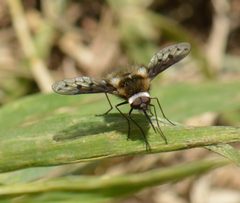
Bombylius albicapillus is a of bee fly in the Bombyliidae, occurring in western North America. As a member of the tribe Bombyliini, it shares the characteristic -mimicking appearance common to this group. The species name "albicapillus" (white-headed) refers to a distinctive pale coloration on the . Like other Bombylius species, are likely active in spring and associated with flowers, though specific biological details remain poorly documented.
Pronunciation
How to pronounce Bombylius albicapillus: //bɒmˈbɪliʊs æl.bɪˈkæ.pɪ.ləs//
These audio files are automatically generated. While they are not always 100% accurate, they are a good starting point.
Identification
Distinguished from by the white or pale coloration on the (referenced in the specific epithet "albicapillus"). Within the Bombylius, identification to level requires examination of head coloration and other subtle morphological features. The genus Bombylius can be separated from similar genera such as Systoechus by the position of the r-m on the wing, though this character requires careful examination. Members of Bombylius tend to be active as in spring, while Systoechus species are more commonly encountered in fall.
Images
Habitat
Western North America; specific microhabitat preferences are undocumented but likely includes open, sunny areas with flowers similar to .
Distribution
Western North America.
Seasonality
activity period is undocumented, but based on -level patterns for Bombylius, likely active in spring.
Similar Taxa
- Bombylius majorLarger and more widespread 'Greater Bee Fly' with dark-edged wings; differs in size, wing pattern, and likely coloration
- Bombylius mexicanusSimilar spring-active ; specific distinguishing features require detailed examination of morphological characters
- Systoechus spp.Similar bee fly distinguished by wing venation (position of r-m ) and typically fall activity period
Sources and further reading
- BugGuide
- Wikipedia
- GBIF taxonomy match
- iNaturalist taxon
- Catalogue of Life
- Beware the bee fly - Bombylius sp. — Bug of the Week
- One-Shot Wednesday: Upside down bee fly | Beetles In The Bush
- Bug Eric: Fly Day Friday: Greater Bee Fly
- Bug Eric: Bee Flies
- Diptera | Beetles In The Bush | Page 5
- Bombyliidae | Beetles In The Bush | Page 2