
Hemipenthes lepidota
(Osten Sacken, 1887)
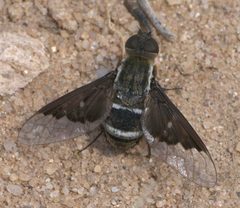
Hemipenthes lepidota is a of bee fly in the Bombyliidae. As a member of the Hemipenthes, its larvae are hyper- that parasitize the larvae of other parasitic insects, including ichneumon wasps and tachinid flies, which themselves are parasites of and caterpillars. are likely flower visitors, feeding on nectar with their elongated . The species was described by Osten Sacken in 1887 and belongs to the Anthracinae.
Pronunciation
How to pronounce Hemipenthes lepidota: /ˌhɛmɪˈpɛnθiːz ˌlɛpɪˈdoʊtə/
These audio files are automatically generated. While they are not always 100% accurate, they are a good starting point.
Images
Diet
feed on nectar using an elongated . Larvae are hyper-, parasitizing the larvae of ichneumon wasps, tachinid flies, and other parasitic insects that attack and caterpillars.
Host Associations
- ichneumon wasps - larval hyper-parasitizes larvae of these parasitic
- tachinid flies - larval hyper-parasitizes larvae of these parasitic flies
- butterfly and moth caterpillars - indirectultimate through hyper- chain
Behavior
likely hover at flowers to feed on nectar. Larval involves hyper-, with larvae seeking out and parasitizing the larvae of other parasitic insects.
Ecological Role
Functions as a hyper-, occupying the fourth by parasitizing other . This complex parasitic relationship may influence of both primary parasitoids and their herbivorous .
Human Relevance
May provide indirect benefits by suppressing of parasitic and flies, though this effect is complex and context-dependent.
Similar Taxa
- Hemipenthes eumenescongeneric with similar hyper-parasitic larval and
- other Bombyliidae genera (e.g., Villa, Bombylius)share -level traits including -like appearance and parasitic larvae, but differ in larval relationships and specific morphological details
More Details
Taxonomic note
Hemipenthes lepidota was originally described by Osten Sacken in 1887. The Hemipenthes is placed in the tribe Villini within Anthracinae.
Life history complexity
The hyper-parasitic lifestyle of Hemipenthes larvae represents a relatively uncommon trophic strategy, requiring the presence of both primary and their herbivorous for successful development.