
Labia minor
(Linnaeus, 1758)
lesser earwig, small earwig
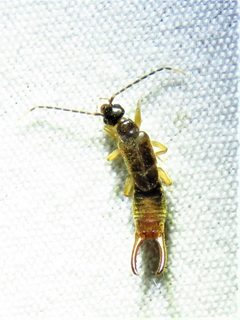
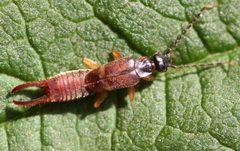
minor is a small , 4–7 mm in length including pincers, distinguished by its dull yellow-brown to chocolate brown coloration and less shiny appearance compared to the common earwig. It is notable as the first Dermapteran species to have its sequenced by the Darwin Tree of Life project. The species exhibits exceptional maternal care , with females guarding and feeding offspring for 1–2 weeks after hatching—a rarity among insects. Unlike many earwigs, it flies frequently and possesses visible hind wings.
Pronunciation
How to pronounce Labia minor: /ˈlæbiə ˈmaɪnɔr/
These audio files are automatically generated. While they are not always 100% accurate, they are a good starting point.
Identification
Smaller than Forficula auricularia (approximately half the size), with dull yellow-brown to chocolate brown coloration that is less shiny than the chestnut brown of the common earwig. Body covered with fine yellow setae; paler than body. Pincers slender and slightly curved in males, lacking teeth in both sexes—distinct from the more robust, toothed pincers of F. auricularia. Hind wings visible and functional; flies frequently, unlike F. auricularia which rarely flies.
Images
Habitat
Environments rich in decaying organic material, particularly warm, actively decomposing compost heaps where heat from decomposition provides favorable thermal conditions. In cooler temperate regions, restricted to warm microhabitats generated by biological activity.
Distribution
Widespread in temperate zones globally. Native to Europe; introduced to Australia, Madeira, Galápagos Islands, and Philippines. In North America, present from British Columbia and Quebec (the only in Quebec) southward; first U.S. record dates to 1838, though possibly present earlier. In the UK and Ireland, occurs in approximately half the region, excluding most northerly areas—more restricted range than Forficula auricularia.
Diet
Feeds on decaying plant material and detritus.
Life Cycle
Development includes and nymphal stages. Eggs guarded by female. Nymphs receive maternal care: female feeds young for 1–2 weeks after hatching.
Behavior
Exhibits remarkable maternal care: female guards and continues to feed offspring for one to two weeks after hatching. Flies frequently, using pincers to unfurl wings in preparation for . Most often encountered when turning compost in cooler climates.
Ecological Role
Contributes to decomposition of organic matter in compost and detritus-rich .
Human Relevance
Minor pest status: occasionally encountered in compost heaps and garden settings. sequenced as first representative of order Dermaptera, providing foundational genomic resource for research.
Similar Taxa
- Forficula auriculariaCommon earwig; distinguished by larger size (8–16 mm), chestnut brown shinier coloration, robust toothed pincers, and infrequent .
Sources and further reading
- BugGuide
- Wikipedia
- GBIF taxonomy match
- iNaturalist taxon
- NCBI Taxonomy
- Catalogue of Life
- Redwinged Grasshopper
- quiz | Beetles In The Bush | Page 7
- Six new Dracula ants from Madagascar: Minor workers become queens in Mystrium | Blog
- Super Crop Challenge #9 | Beetles In The Bush
- European biodiversity | Blog
- New ant species explodes to defend its colony | Blog
- The genome sequence of the lesser earwig, Labia minor (Linnaeus, 1758).