
Doru taeniatum
(Dohrn, 1862)
lined earwig
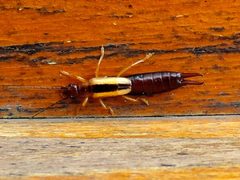
Doru taeniatum, the lined , is a earwig in the Forficulidae. It is native to the Americas, ranging from North America through Central America to South America. The species has been studied extensively for its potential role in , particularly in maize agroecosystems where it preys on pest lepidopterans including the fall armyworm (Spodoptera frugiperda). Laboratory studies indicate it is , capable of completing development and on plant pollen or lepidopteran alone, with optimal on mixed or egg-only diets.
Pronunciation
How to pronounce Doru taeniatum: //ˈdɔːru ˌtaɪniˈeɪtəm//
These audio files are automatically generated. While they are not always 100% accurate, they are a good starting point.
Images
Habitat
Maize fields in Mesoamerican agricultural systems; broader natural requirements not documented in available sources.
Distribution
North America, Central America, and South America.
Diet
. Under laboratory conditions, capable of development and on plant pollen alone or lepidopteran (Sitotroga cerealella) alone. Most rapid development and highest observed when fed Sitotroga cerealella eggs with pollen, or S. cerealella eggs alone. Preys on Spodoptera frugiperda larvae in field maize crops.
Host Associations
- Spodoptera frugiperda - -preyReported of fall armyworm larvae in maize fields; has been observed to direct greater proportion of attacks toward virus-infected prey.
- Sitotroga cerealella - -preyLaboratory prey source; used as sole food source capable of supporting complete development and .
Life Cycle
Develops through 4 nymphal instars; reaches in approximately 30 days under laboratory conditions. Females tend and first instar nymphs.
Behavior
Females exhibit parental care by tending and first instar nymphs. Mates readily under laboratory conditions. Prey consumption is rapid compared to some sympatric . In feeding trials, directed greater proportion of attacks toward virus-infected Spodoptera frugiperda larvae compared to healthy prey, with no significant difference in search time. Capable of dispersing viable in for up to 3 days after feeding on infected prey.
Ecological Role
in agricultural , particularly maize fields. Potential agent for fall armyworm (Spodoptera frugiperda) management. Demonstrated capacity to transmit to pest through fecal of foliage, achieving 4.7% transmission in field conditions.
Human Relevance
Evaluated as a agent for dispersing Spodoptera frugiperda in maize crops. Laboratory-reared for study of and .
More Details
Laboratory rearing notes
Easily reared under laboratory conditions; basic well-documented from captive studies. Field and natural history remain poorly characterized.
Virus vector potential
Unlike Chrysoperla rufilabris, which inactivates virus in its acidic gut, D. taeniatum maintains viable virus in for up to 3 days, enabling mechanical transmission to pest .