
Cryptoglossa variolosa
(Horn, 1870)
Black Death-feigning Beetle
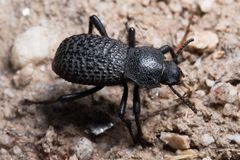
Cryptoglossa variolosa is a of darkling beetle in the Tenebrionidae, commonly known as the Black Death-feigning . It occurs in arid regions of Mexico and the southwestern United States. The species is notable for its ability to feign death () when disturbed. It is one of several Cryptoglossa species adapted to desert environments.
Pronunciation
How to pronounce Cryptoglossa variolosa: //ˌkrɪptoʊˈɡlɒsə ˌvɛəriəˈloʊsə//
These audio files are automatically generated. While they are not always 100% accurate, they are a good starting point.
Identification
Best identified by its uniformly black, smooth, and highly convex body combined with its desert . It can be separated from other Cryptoglossa by subtle differences in elytral and body proportions, though precise identification may require examination of genitalia or comparison with reference specimens. The refers to its death-feigning , which can be tested by gentle disturbance. Similar darkling beetles in the same region often show more pronounced surface texture, lighter coloration, or more elongate body forms.
Images
Habitat
Arid and semi-arid environments including desert scrub, rocky slopes, and sandy washes. Found in areas with sparse vegetation where it shelters under rocks, debris, or in soil crevices during the day to avoid desiccation and extreme temperatures.
Distribution
Recorded from Mexico and the southwestern United States (Arizona, New Mexico, southern California, and adjacent regions). Distribution records indicate presence in the Sonoran and Chihuahuan Desert regions.
Seasonality
are active primarily during warmer months, with peak activity in spring and summer. Activity patterns are influenced by rainfall and temperature, with beetles becoming surface-active following moisture events. activity predominates during hot periods.
Behavior
Exhibits (death-feigning) when disturbed, becoming immobile and tucking legs tightly against the body. This reduces detection by and is the source of its . Primarily , emerging from shelter to forage during cooler nighttime hours. Seeks under rocks or in burrows during daylight hours to avoid heat and desiccation.
Ecological Role
Functions as a in desert , contributing to nutrient cycling through consumption of decaying plant material. Serves as prey for various vertebrate and . Its burrowing activity may contribute to soil aeration in localized areas.
Human Relevance
Occasionally kept in captivity as a pet or educational specimen due to its hardy nature, ease of care, and interesting defensive . Has been used in behavioral studies of . Not considered a pest .
Similar Taxa
- Cryptoglossa muricataOccurs in similar desert and shares the ; differs in having more pronounced elytral or rougher surface texture
- Asbolus verrucosusAnother black desert tenebrionid with death-feigning ; distinguished by more warty or tuberculate elytral surface and different geographic range
- Eleodes spp.Common darkling beetles in same region; generally more elongate in body form and often with lighter coloration or distinct defensive posture (headstand) rather than
More Details
Conservation status
Not formally assessed; appears to be common and widespread within its range based on observation records. No known conservation concerns.
Taxonomic notes
The Cryptoglossa is part of the diverse Tenebrionidae fauna of North American deserts. boundaries within the genus have been historically difficult to determine based on external alone.