
Coelus pacificus
Fall, 1897
Channel Islands Dune Beetle
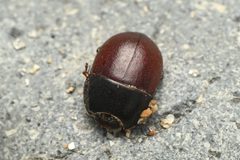
Coelus pacificus is a darkling beetle ( Tenebrionidae) to the California Channel Islands. It inhabits dune environments across multiple islands, with distinct phylogeographic structure separating northern island (Santa Cruz, Santa Rosa, San Miguel, San Nicolas) from southern populations (Santa Catalina, San Clemente). The is morphologically similar to the mainland Coelus ciliatus but represents a valid, independently evolving lineage. Conservation concerns arise from its restricted insular distribution and vulnerability to disturbance.
Pronunciation
How to pronounce Coelus pacificus: //ˈsiːləs pəˈsɪfɪkəs//
These audio files are automatically generated. While they are not always 100% accurate, they are a good starting point.
Identification
Distinguished from mainland Coelus ciliatus by genetic analysis of oxidase I (COI) mitochondrial sequences; two distinct haplotype clades exist within C. pacificus corresponding to northern and southern island groups. Some island haplotypes are morphologically indistinguishable from C. ciliatus, requiring molecular methods for definitive identification.
Images
Habitat
Dune on the California Channel Islands; specifically associated with sandy coastal dune environments
Distribution
to six California Channel Islands: Santa Cruz, Santa Rosa, San Miguel, San Nicolas (northern clade); Santa Catalina and San Clemente (southern clade). Not naturally occurring on mainland California.
Similar Taxa
- Coelus ciliatusMainland with overlapping ; some C. pacificus haplotypes are morphologically indistinguishable, requiring genetic analysis for separation
More Details
Phylogeographic structure
Two distinct mitochondrial clades: northern clade (Santa Cruz, Santa Rosa, San Miguel, San Nicolas islands) and southern clade (Santa Catalina, San Clemente). Highest haplotypic diversity occurs on San Clemente and San Nicolas islands. All six inhabited islands harbor unique haplotypes, supporting separate management for genetic integrity.
Conservation implications
The California Channel Islands should be managed on a system-wide basis for some organisms and , but each island's C. pacificus requires separate management to protect genetic integrity due to limited inter-island .
Sources and further reading
- BugGuide
- GBIF taxonomy match
- iNaturalist taxon
- NCBI Taxonomy
- It Started Out as a Quiet, End-of-the-Year Hike Near Lake Berryessa... | Bug Squad
- Spring Conditions Predict Following Year's Tick Activity in Northern California
- Cold-Season Temperature and Rainfall Drive Climate Suitability for Ticks in California
- CDC Study Shares County Maps of 7 Diseases Spread by Blacklegged Ticks
- Mapping Lyme: CDC Reveals Distribution of Lyme Disease-Causing Bacteria by County
- Ticks that Transmit Lyme Disease Reported in 48.6% of U.S. Counties
- Multi-Island Endemicity: Phylogeography and Conservation of Coelus pacificus (Coleoptera: Tenebrionidae) Darkling Beetles on the California Channel Islands