
Eleodes opaca
(Say, 1824)
Plains False Wireworm Beetle, Plains False Wireworm
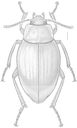
Eleodes opaca is a large darkling beetle ( Tenebrionidae) native to the Great Plains of North America. are primarily black with a distinctive reddish-brown sutural stripe running along the . The exhibits the characteristic defensive headstand common to the Eleodes, earning it the 'clown beetle.' It is frequently encountered across grasslands and roads, particularly following summer rains.
Pronunciation
How to pronounce Eleodes opaca: /ˈɛ.li.oʊˌdiːz oʊˈpeɪ.kə/
These audio files are automatically generated. While they are not always 100% accurate, they are a good starting point.
Identification
Eleodes opaca is distinguished from similar Great Plains Eleodes by its sharply laterally carinate (keeled) and broadly explanate (flanged, spread outward flatly) pronotum. The elytra are distinctly flattened rather than rounded. These features separate it from E. hispilabris, E. acuta, and E. obscurus, which possess more rounded elytra and less pronounced pronotal flanges. E. acuta averages larger (approximately 30 mm versus under 26 mm for E. opaca) and has upturned rather than explanate pronotal borders. E. hispilabris possesses a normal first tarsal segment on the foreleg (not thickened apically). The reddish-brown sutural stripe occurs in E. opaca and occasionally in these similar species, making it unreliable for identification alone.
Images
Habitat
Mixed-grass prairie and open grasslands in the Great Plains. are commonly observed on the ground surface or crossing roads, with activity increasing after summer rains.
Distribution
Great Plains of North America. Documented from Alberta, Manitoba, and Saskatchewan in Canada; distribution extends southward through the central United States including Oklahoma, Kansas, South Dakota, and New Mexico.
Seasonality
are active during summer months, with peak activity occurring after rainfall events.
Behavior
When disturbed, assume a characteristic defensive headstand pose with the elevated and directed toward the threat. This , combined with the release of noxious defensive compounds containing benzoquinone and other hydrocarbons, deters . Adults are primarily and walk with a distinctive clambering gait.
Human Relevance
The is kept as a low-maintenance pet due to its simple care requirements and long lifespan in captivity. Commonly known as 'plains ,' with larvae presumably sharing this name.
Similar Taxa
- Eleodes suturalisFormerly considered a distinct but now synonymized with E. opaca; historical literature may use this name for the same .
- Eleodes hispilabrisCo-occurs in Great Plains and resembles E. opaca in size, coloration, and sometimes the reddish-brown sutural stripe; distinguished by rounded and normal first foreleg tarsal segment.
- Eleodes acutaCo-occurs in Great Plains with similar coloration; larger on average (30 mm versus <26 mm) with upturned rather than explanate pronotal borders.
- Eleodes obscurusCo-occurs in Great Plains and similar in general appearance; distinguished by rounded .