
Eleodes acuticauda
LeConte, 1851
desert stink beetle
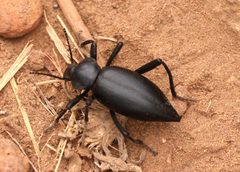
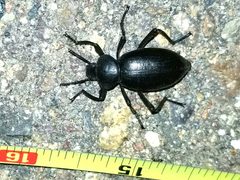
A large desert stink beetle in the Tenebrionidae, native to southwestern North America. Distinguished from similar by its strongly arcuate pronotum with dentate projections, spines on the front legs, and absence of golden hairs on the underside of the legs. Often found in arid and semi-arid including mixed-grass prairie.

Pronunciation
How to pronounce Eleodes acuticauda: /ɛˈliːoʊˌdiːz əˌkjuːtɪˈkɔːdə/
These audio files are automatically generated. While they are not always 100% accurate, they are a good starting point.
Identification
Pronotum strongly arcuate, approximately twice the width of the , with dentate projections on the corners. Distinguished from Coelocnemis by spines on the front legs and lack of golden hairs on the underside of the legs. Differs from the similar Eleodes suturalis in having upturned (rather than rounded) lateral borders of the pronotum; averages larger at approximately 30 mm compared to E. suturalis typically under 26 mm. Both share the reddish-brown sutural stripe on dark .
Images
Habitat
Arid and semi-arid environments including mixed-grass prairie and desert regions.
Distribution
Southwestern North America; recorded from Mexico and the southwestern United States including New Mexico (White Sands area) and South Dakota.
Behavior
Performs the defensive " stand" characteristic of Eleodes when disturbed, elevating the to release defensive secretions.
Similar Taxa
- Eleodes suturalisNearly identical in coloration with dark body and reddish-brown sutural stripe; distinguished by rounded (not upturned) lateral pronotal borders and smaller average size (under 26 mm vs. ~30 mm). Both occur sympatrically in the same .
- Eleodes hispilabrisSimilar size and coloration with reddish-brown sutural stripe; distinguished by different pronotal shape and other subtle morphological differences.
- CoelocnemisSimilar general appearance; distinguished by absence of spines on front legs and presence of golden hairs on underside of legs in Coelocnemis.