
Zonitis atripennis
(Say, 1823)
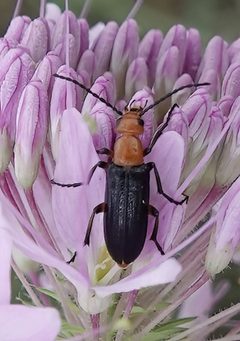
Zonitis atripennis is a blister beetle in the Meloidae, found in North America. feed on plants of the Cleome, while larvae develop as kleptoparasites in nests of various . The species was described by Thomas Say in 1823 and includes two recognized : Z. a. atripennis and Z. a. terminalis.
Pronunciation
How to pronounce Zonitis atripennis: /zəˈnaɪtɪs ˌætrɪˈpɛnɪs/
These audio files are automatically generated. While they are not always 100% accurate, they are a good starting point.
Identification
can be distinguished from similar Zonitis by the combination of black (wing covers) and specific antennal and pronotal characteristics. The nominate Z. a. atripennis differs from Z. a. terminalis in details of elytral punctuation and body proportions. Accurate identification typically requires examination of genitalic structures and comparison with .
Images
Habitat
are found in open, sunny where plants of the Cleome grow. Larvae occur within the nests of ground-nesting or cavity-nesting bees, where they feed on stored provisions and possibly on bees.
Distribution
North America. Records include the southwestern United States and adjacent regions, with showing somewhat different ranges: Z. a. terminalis has been recorded from Arizona and surrounding areas.
Seasonality
are active during summer months when Cleome plants are in bloom. Activity patterns likely vary geographically with local climate and plant .
Diet
feed on pollen, nectar, and floral tissues of Cleome . Larvae are kleptoparasites in nests, consuming stored pollen and nectar provisions.
Host Associations
- Cleome - food plant feed on plants of this
- bee nests - larval development siteLarvae develop within nests of various
Life Cycle
Complete with hypermetamorphic larvae typical of Meloidae. First-instar larvae (triungulins) are active and seek out nests, where subsequent instars feed on stored provisions. occurs within the bee nest.
Behavior
are flower visitors. Larvae exhibit phoretic in their first instar, attaching to bees to gain transport to nests. This does not exhibit the extreme maxillary elongation seen in related like Nemognatha.
Ecological Role
function as while feeding on flowers. Larvae act as kleptoparasites of bees, potentially impacting local through competition for nest provisions.
Human Relevance
Like other blister beetles, contain and may cause blistering if handled. They are not considered significant agricultural pests despite feeding on Cleome, which includes some cultivated ornamental .
Similar Taxa
- Zonitis sayiOverlapping range and similar habits; distinguished by elytral coloration and punctation patterns
- Zonitis dunnianaSympatric in some areas; differs in body shape and antennal proportions
- Pseudozonitis speciesFormerly confused with Zonitis; separated by genitalic and antennal characters per Enns (1956)
More Details
Taxonomic history
The was revised by W.R. Enns in 1956 as part of his comprehensive treatment of North American Nemognathinae. The Z. a. terminalis was described by Enns in 1956 based on specimens from Arizona.
Mouthpart morphology
Unlike the highly elongated of Nemognatha and Gnathium, Zonitis have relatively unmodified mouthparts adapted for feeding on open flowers rather than deep corollas.