
Pseudozonitis pallidus
Dillon, 1952
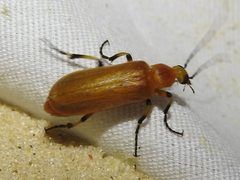
Pseudozonitis pallidus is a blister beetle in the Meloidae, described by Dillon in 1952. It belongs to the Nemognathinae, a group characterized by elongated maxillary mouthparts adapted for nectar feeding. The species occurs in North America. Like other nemognathine blister beetles, likely feed on floral resources, though specific details of its remain poorly documented.
Pronunciation
How to pronounce Pseudozonitis pallidus: /ˌpsuːdoʊˈzoʊnɪtɪs ˈpælɪdəs/
These audio files are automatically generated. While they are not always 100% accurate, they are a good starting point.
Identification
Pseudozonitis pallidus can be distinguished from by its pallid (pale) coloration, as suggested by its specific epithet. Within the Pseudozonitis, identification relies on subtle differences in coloration, body proportions, and male genitalic structures. The genus is distinguished from related genera Nemognatha and Zonitis by features of the mouthparts and genitalia. possess the elongated maxillary characteristic of Nemognathinae, though the exact length relative to body size is not documented for this .
Images
Distribution
North America. Specific records are sparse; the has been documented in museum collections with 11 specimens at the Entomology Research Museum (J. Pinto collection, 2010). GBIF records confirm presence in North America.
Similar Taxa
- Pseudozonitis vittipennisSimilar size and body form; distinguished by vittate (striped) elytral pattern versus uniform pallid coloration in P. pallidus.
- Pseudozonitis arizonicaOverlaps in geographic range; differs in coloration and male genitalic structure.
- Pseudozonitis longicornisShares elongated characteristic of some Pseudozonitis ; distinguished by antennal proportions and body coloration.
- Nemognatha speciesRelated nemognathine with similar elongated mouthparts; distinguished by differences in maxillary structure and genitalia.
More Details
Taxonomic history
The Pseudozonitis was established by Enns (1956) in his revision of North American Nemognathinae, separating it from Nemognatha and Zonitis based on morphological characters. Pseudozonitis pallidus was described by Dillon in 1952, prior to Enns' revision, and was subsequently placed in Pseudozonitis.
Nomenclatural note
The name has appeared as 'pallida' in some sources (e.g., museum holdings list), but the correct ending for the masculine Pseudozonitis is 'pallidus'.
Research needs
Basic biological information including larval associations, flower preferences, and detailed distribution records remain undocumented for this .