
Nemognatha punctulata
LeConte, 1853
Nemognatha punctulata is a of blister beetle in the Meloidae, Nemognathinae. Like other members of its , it possesses elongated maxillary mouthparts adapted for feeding on flower nectar. The species is found in North America. It belongs to a group of meloid beetles whose nectar-feeding mechanism involves capillary action rather than true sucking.
Pronunciation
How to pronounce Nemognatha punctulata: /nɛmoʊˈɡnæθə pʌŋktʃəˈleɪtə/
These audio files are automatically generated. While they are not always 100% accurate, they are a good starting point.
Identification
Members of Nemognatha are distinguished from other meloid by their greatly elongated mouthparts, with the (specifically the ) extended to access nectar in deep-corolla flowers. Nemognatha punctulata specifically can be identified by the punctate (spotted) elytral pattern referenced in its epithet. The genus is further characterized by , bristle-covered galeae that function via capillary action for nectar uptake rather than forming a sealed food canal. The species lacks the extremely elongated maxillae seen in some such as N. chrysomeloides, where the mouthparts exceed body length.
Images
Distribution
North America. Museum holdings indicate presence in the southwestern United States, with collection records from northwestern Oklahoma in shortgrass prairie with oak/pine/juniper woodland and sandstone outcrops.
Seasonality
have been observed in early to mid-May in Oklahoma, suggesting spring activity period.
Diet
feed on flower nectar and pollen. Nectar uptake occurs via capillary action along bristle-covered maxillary rather than through sucking. Pollen is consumed using standard chewing .
Behavior
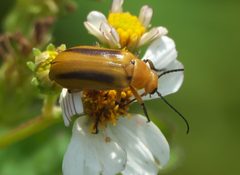
are flower visitors, found on yellow composite flowers (Asteraceae). Like other Nemognathini, they are and likely slow-moving. The elongated mouthparts are adapted for accessing nectar from flowers with deep corollas.
Ecological Role
function as through their flower-visiting . As with other Meloidae, larvae are likely or , though specific details for this are unconfirmed.
Similar Taxa
- Nemognatha nigripennisSimilar flower-visiting blister beetle found in same and region; distinguished by darker wing coloration and different elytral pattern
- Nemognatha luteaCongeneric with similar elongated mouthpart ; N. lutea is notably abundant in collections and may differ in coloration and punctation pattern
- Gnathium spp.Related nemognathine with similarly elongated maxillary mouthparts for nectar feeding; distinguished by different body form and antennal structure
Misconceptions
The elongated mouthparts of Nemognatha and related have been historically mischaracterized as 'sucking' proboscides in entomological literature. Research by Wilhelmi & Krenn (2012) demonstrated that no food canal exists; instead, nectar is transported via capillary action along the bristle-covered outer surfaces of the , with musculature around the mouth aiding transport rather than creating suction.
More Details
Taxonomic history
Described by LeConte in 1853. The Nemognatha was revised by Enns (1956), who documented the relationship between maxillary length and flower corolla depth preferences among .
Mouthpart morphology
The elongated of N. punctulata are covered with long bristles and lack the concave inner surfaces that would form a functional food canal. This represents a distinct evolutionary solution to nectar feeding separate from the true sucking mouthparts of Lepidoptera or some other beetles.