
Pyrota trochanterica
Arizona Trochanter Blister Beetle
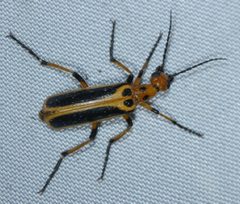
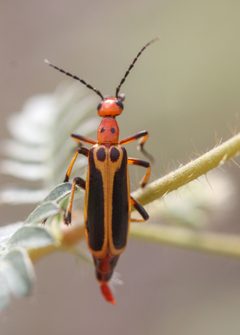
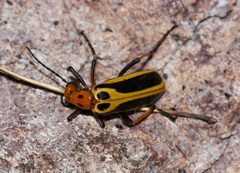
Pyrota trochanterica is a blister beetle in the Meloidae, native to the southwestern United States. The exhibits two recognized : the nominate P. t. trochanterica and P. t. werneri. Like other members of the Pyrota, it possesses aposematic coloration warning of its chemical defenses. The species is known to aggregate on flowers, particularly yellow-flowered shrubs, where mating occurs.
Pronunciation
How to pronounce Pyrota trochanterica: /paɪˈroʊtə troʊˌkæntəˈrɪkə/
These audio files are automatically generated. While they are not always 100% accurate, they are a good starting point.
Identification
Pyrota trochanterica can be distinguished from by features of the , as implied by the epithet. The nominate P. t. trochanterica and P. t. werneri are distinguished by subtle morphological differences established by Selander. Within the Pyrota, species identification relies on color pattern, pronotal shape, and male genitalia. The genus is characterized by soft-bodied beetles with thread-like and often striking orange, black, and white color patterns.
Images
Habitat
Arid and semi-arid environments of the southwestern United States, including desert scrub and grassland . Associated with flowering vegetation, particularly yellow-flowered shrubs such as rabbitbrush (Chrysothamnus/Ericameria ).
Distribution
Southwestern United States. The nominate P. t. trochanterica has been documented from Arizona and surrounding areas, while P. t. werneri occurs in Texas and adjacent regions.
Seasonality
are active during summer months, with peak activity coinciding with flowering of shrubs. Mating form on blossoms during this period.
Behavior
Forms mating on flowers. Exhibits extreme sexual size dimorphism, with males sometimes less than half the size of females. Males transfer containing to females during mating.
Ecological Role
As a blister beetle, produces as a chemical defense against . are flower visitors and may contribute to pollination, though this has not been quantified. Larvae are likely hypermetamorphic or predators of ground-nesting bees, as is typical for the Meloidae, though specific remain undocumented.
Human Relevance
Contains , a toxic compound that can cause blistering upon contact with skin. Livestock poisoning can occur if beetles are consumed in hay or forage, though specific incidents involving this are not documented. The species is of interest to entomologists studying sexual size dimorphism and mating systems.
Similar Taxa
- Pyrota bilineataSimilar orange and black coloration with striped , but differs in specific pattern elements and geographic range (P. bilineata occurs further north in the Great Basin and Rocky Mountain regions)
- Pyrota palpalisShares yellow-orange and black aposematic coloration, but P. palpalis has distinctive palpal and different elytral maculation
- Pyrota posticaOverlapping range in the Southwest, but differs in pronotal and elytral pattern; P. postica typically shows more extensive black markings on the pronotum