
Pyrota bilineata
Horn, 1885
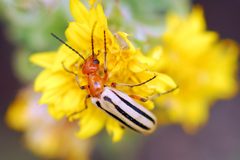
Pyrota bilineata is a blister beetle ( Meloidae) distributed across western North America. The exhibits extreme sexual size dimorphism, with males frequently less than half the size of females. are and commonly observed feeding and mating on flowers of yellow rabbitbrush (Chrysothamnus viscidiflorus) and related Asteraceae. Like other meloids, it produces , a defensive compound that renders it unpalatable to .
Pronunciation
How to pronounce Pyrota bilineata: /paɪˈroʊtə ˌbaɪlɪˈniːətə/
These audio files are automatically generated. While they are not always 100% accurate, they are a good starting point.
Identification
Orange to reddish-orange with two distinct black longitudinal stripes running the length of each wing cover. Pronotum bears two black spots. and legs black. Body moderately elongated, typical of Pyrota. Distinguished from similar Pyrota by the specific configuration of the paired elytral stripes and pronotal spotting pattern.
Images
Habitat
Arid and semi-arid shrublands, particularly areas dominated by rabbitbrush (Chrysothamnus) and related Asteraceae. Observed at elevations from desert floors to montane shrub zones.
Distribution
Western North America, including Utah, Colorado, New Mexico, Arizona, and adjacent regions. Records from San Juan County, Utah; southwestern Colorado; and central New Mexico.
Seasonality
active primarily during late summer, with observations in August and September. Peak activity coincides with flowering of shrubs.
Diet
feed on flowers and foliage of Asteraceae, particularly Chrysothamnus viscidiflorus (yellow rabbitbrush). Larval diet unknown but presumed to include pods or larvae, based on -level .
Host Associations
- Chrysothamnus viscidiflorus - food plantPrimary flower ; congregate on blossoms
Behavior
Forms mating on plant flowers. Mating pairs may remain coupled for extended periods. Extreme size dimorphism results in markedly differently-sized mating pairs; smaller males observed successfully mating with substantially larger females, suggesting absence of strict size-assortative mating in this .
Ecological Role
of Asteraceae through flower visitation. Chemical defense via may influence -prey dynamics in .
Human Relevance
Minimal direct economic impact. Like other blister beetles, contains and should not be handled extensively. occasionally encountered by entomologists and nature observers in western North America.
Similar Taxa
- Pyrota lineataOverlapping distribution and similar orange coloration; distinguished by elytral stripe pattern and pronotal markings
- Pyrota palpalisSympatric in portions of range; requires examination of mouthpart and genitalic characters for definitive separation