
Pyrota lineata
(Olivier)
Yellow-lined Pyrota
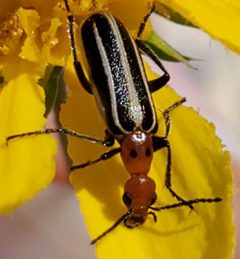
Pyrota lineata is a blister beetle in the Meloidae, tribe Pyrotini. It is characterized by yellow longitudinal stripes on dark and is found in western North America. The is documented in museum collections and has been observed in multiple localities. Like other Pyrota species, it exhibits the typical meloid soft-bodied form and elytra that do not fully cover the .
Pronunciation
How to pronounce Pyrota lineata: //paɪˈroʊtə lɪˈniːətə//
These audio files are automatically generated. While they are not always 100% accurate, they are a good starting point.
Identification
Distinguished from other Pyrota by the specific pattern of yellow longitudinal stripes on dark . Differs from Pyrota bilineata (which has two black pronotal spots and orange coloration) and Pyrota palpalis (Charlie Brown blister beetle with different pronotal coloration). Separated from Epicauta species by elytral stripe pattern and body proportions. Distinguished from other meloid by combination of striped elytra, exposed , and overall body form characteristic of Pyrotini.
Images
Appearance
Medium-sized blister beetle with soft, flexible that leave the terminal abdominal segments exposed. Elytra dark with distinct yellow longitudinal stripes. Pronotum typically dark, often with contrasting markings. , moderately long. Body form elongate, typical of Pyrota.
Habitat
Associated with flowering vegetation in arid and semi-arid regions. Documented from mesquite-acacia scrub and creosote bush . Likely associated with plants for larval development, as with other meloid beetles.
Distribution
Western North America. Documented from museum holdings and field observations in southwestern United States including Texas, New Mexico, and Arizona. Specific range details limited in available sources.
Seasonality
active during summer months. Museum specimen data and field observations indicate activity from late spring through summer, with peak activity likely corresponding to flowering periods of vegetation.
Behavior
likely feed on flowers and foliage of plants. Mating not specifically documented for this , but related Pyrota species form on flowering plants. Exhibits typical meloid defensive behavior, releasing when disturbed.
Ecological Role
As a phytophagous , contributes to herbivory in desert and semi-desert . production provides chemical defense against . Role in pollination minimal; primarily a nectar and foliage consumer.
Human Relevance
Contains and may be toxic if ingested. No specific economic significance documented. Of interest to entomologists studying meloid diversity in southwestern North America.
Similar Taxa
- Pyrota bilineataSimilar striped elytral pattern but has orange coloration with two distinct black pronotal spots
- Pyrota palpalisSimilar body form but has distinctive pronotal coloration (Charlie Brown blister beetle)
- Epicauta speciesSimilar soft-bodied meloid form but different elytral pattern and usually more robust body proportions
More Details
Taxonomic History
Described by Olivier; the specific epithet 'lineata' refers to the lined or striped elytral pattern. Placed in Pyrota, tribe Pyrotini, which includes approximately 20+ primarily distributed in the Americas.
Museum Holdings
Represented in the Entomology Research Museum Meloidae Holdings with 6 specimens as of 2010, curated by J. Pinto.