
Pyrota postica
LeConte, 1858
Creosote Blister Beetle
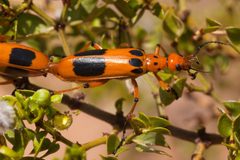
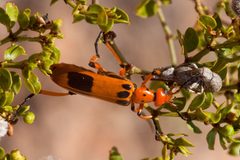
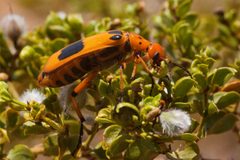
Pyrota postica is a blister beetle in the Meloidae, commonly known as the Creosote Blister Beetle due to its strong association with Larrea tridentata (creosote bush). The occurs in the southwestern United States and Mexico. are typically observed in on flowering creosote bushes, where they feed on floral parts and foliage. Like other meloids, this species possesses , a defensive compound that can cause skin blistering in humans.
Pronunciation
How to pronounce Pyrota postica: //paɪˈroʊtə ˈpɒstɪkə//
These audio files are automatically generated. While they are not always 100% accurate, they are a good starting point.
Identification
Pyrota postica can be distinguished from other Pyrota by its coloration and pattern. Members of the Pyrota are generally recognized by their elongated body form, soft , and often striking red and black or orange and black color patterns. Specific identification to species level requires examination of pronotal and elytral markings, antennal structure, and male genitalia. The species is most readily identified in the field by its consistent association with creosote bush in the Chihuahuan and Sonoran Desert regions.
Images
Habitat
Arid and semi-arid desert scrub, specifically creosote bush-dominated . are found on Larrea tridentata (creosote bush) in both pure stands and mixed desert vegetation. The occurs in sandy to rocky desert soils at low to moderate elevations.
Distribution
North America: southwestern United States (Texas, New Mexico, Arizona) and Mexico. The range corresponds closely with that of its plant Larrea tridentata.
Seasonality
are active during summer months, with peak activity in July. Observations indicate adults are present when creosote bush is in flower.
Diet
feed on flowers and leaves of Larrea tridentata (creosote bush). Larval diet is unknown but likely consists of pods or nest provisions, as is typical for the Meloinae.
Host Associations
- Larrea tridentata - food plant feed on flowers and foliage; form on blooming plants
Life Cycle
Complete with hypermetamorphic larvae typical of Meloidae. are laid in soil. First instar larvae (triungulins) are mobile and seek out . Later instars are sedentary and feed within host provisions. Specific details of the for this have not been documented.
Behavior
form on flowering creosote bushes, where they engage in mating and feeding. When disturbed, adults may drop from vegetation or fly short distances. The is and active during daylight hours.
Ecological Role
As a herbivore, contribute to creosote bush flower and foliage consumption. Larvae likely function as or of or native nest provisions. The serves as a source of , which may be sequestered by predators.
Human Relevance
The can be a nuisance to humans due to the presence of in its tissues, which causes blistering upon contact with skin. Livestock may be poisoned if they ingest beetles in forage. The species is of interest to entomologists studying desert insect and plant-insect relationships.
Similar Taxa
- Pyrota palpalisOverlaps in range and ; distinguished by differences in palpal structure and color pattern details
- Pyrota lineataSimilar body form and coloration; distinguished by elytral stripe pattern and geographic distribution
- Eupompha fissicepsAlso occurs on creosote bush in same region; distinguished by different body shape, color pattern (bright green and orange versus red and black), and antennal structure