
Eupompha fissiceps
LeConte, 1858
Cleft-headed Blister Beetle
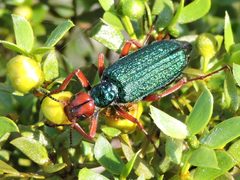
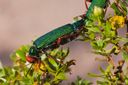
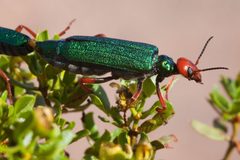
Eupompha fissiceps is a blister beetle in the Meloidae, commonly known as the cleft-headed blister beetle. The occurs in arid regions of southwestern North America and Central America. have been observed feeding on creosote bush (Larrea tridentata) flowers, often in mating . The specific epithet 'fissiceps' refers to a characteristic division or cleft in the structure.
Pronunciation
How to pronounce Eupompha fissiceps: //juːˈpɒmfə ˈfɪsɪsɛps//
These audio files are automatically generated. While they are not always 100% accurate, they are a good starting point.
Identification
The combination of bright green and orange coloration with the distinctive cleft structure distinguishes Eupompha fissiceps from other Eupompha . The Eupompha is characterized by metallic or brightly colored , and E. fissiceps can be separated from similar species such as E. elegans by the head referenced in its name.
Images
Habitat
Arid and semi-arid scrublands, particularly creosote bush-dominated desert . Associated with sandy soils and open, sunny conditions typical of Chihuahuan and Sonoran desert .
Distribution
Found in the southwestern United States (Texas, New Mexico, Arizona) and extending south into Mexico and Central America. Records indicate presence in the Chihuahuan Desert and adjacent regions.
Seasonality
have been observed in July, suggesting peak activity during summer months following monsoon rains when plants are in bloom.
Diet
feed on flowers of Larrea tridentata (creosote bush), consuming petals and floral tissues. Larval diet unknown but likely involves on or of ground-nesting and provisions, as is typical for the tribe Eupomphini.
Host Associations
- Larrea tridentata - food plant feed on creosote bush flowers, often in mating pairs
Life Cycle
Complete with hypermetamorphic larvae typical of Meloidae. First instar larvae (triungulins) are likely mobile and seek out . Subsequent instars are -like and sedentary, developing within host provisions. Specific details of larval development and host associations for this are not documented.
Behavior
are and active on plant flowers during daylight hours. Frequently observed in mating pairs on creosote bush flowers. When disturbed, adults may take or drop to the ground.
Ecological Role
function as floral herbivores on creosote bush. Larvae likely serve as or of ground-nesting bees, potentially influencing in desert . The bright aposematic coloration warns vertebrate predators of the defensive compounds present in tissues.
Human Relevance
Like all blister beetles, contains and should not be handled without caution. Cantharidin can cause skin blistering and is toxic if ingested. The is of interest to entomologists studying desert beetle and meloid . Occasionally encountered by collectors in the southwestern United States.
Similar Taxa
- Eupompha elegansSimilar bright coloration and preferences, but lacks the distinctive cleft structure of E. fissiceps
- Eupompha decolorataOverlapping distribution but with different color pattern and
- Pyrota posticaSimilar size, coloration, and creosote bush association, but belongs to different with different structure and elytral pattern
More Details
Etymology
The specific epithet 'fissiceps' derives from Latin 'fissus' (cleft or divided) and 'ceps' (), directly referencing the diagnostic head .
Taxonomic History
Described by John Lawrence LeConte in 1858, a prominent 19th-century American entomologist who described numerous North American .
Collection Notes
The is represented by 83 specimens in the Entomology Research Museum at the University of California, Riverside, indicating it is moderately well-represented in collections but not commonly encountered in large numbers.