
Eupompha
LeConte, 1858
Species Guides
8- Eupompha edmundsi
- Eupompha elegans(Elegant Blister Beetle)
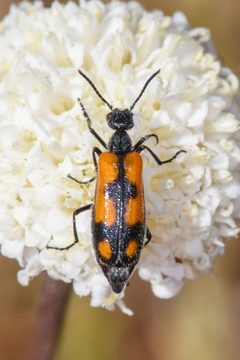
- Eupompha fissiceps(Cleft-headed Blister Beetle)
- Eupompha histrionica
- Eupompha imperialis
- Eupompha schwarzi
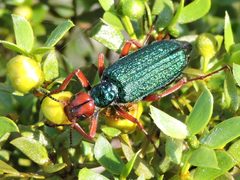
- Eupompha viridis(Green Blister Beetle)
- Eupompha wenzeli(Scintillating Poppy Blister Beetle)
Eupompha is a of blister beetles ( Meloidae) comprising approximately 14 described distributed in arid regions of North America. Members of this genus are characterized by their association with creosote bush (Larrea tridentata) and other desert plants, on which feed and aggregate in mating pairs. The genus belongs to the tribe Eupomphini, which includes other genera with similar desert-adapted ecologies.
Pronunciation
How to pronounce Eupompha: //juːˈpɒmfə//
These audio files are automatically generated. While they are not always 100% accurate, they are a good starting point.
Identification
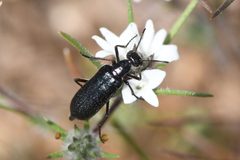
of Eupompha can be distinguished from related in the tribe Eupomphini (such as Cordylospasta, Cysteodemus, and Phodaga) by combinations of color pattern, body shape, and antennal structure. Eupompha elegans exhibits metallic green or blue coloration with contrasting red or orange markings, while Eupompha fissiceps has a distinctive black and orange pattern. Detailed identification to species level requires examination of male genitalia and other structural characters.
Images
Habitat
Arid and semi-arid regions of southwestern North America, including Chihuahuan and Sonoran Desert scrublands. are strongly associated with creosote bush (Larrea tridentata) and other desert shrubs.
Distribution
Southwestern United States and adjacent Mexico, including Texas, New Mexico, Arizona, and California.
Seasonality
are active during summer months, with peak activity in July and August following monsoon rains.
Diet
feed on floral parts and foliage of desert shrubs, particularly creosote bush (Larrea tridentata). Larvae are likely or within nests, as is typical for the Meloinae, though specific records for Eupompha larvae are not documented.
Host Associations
- Larrea tridentata - food plantPrimary ; feed on flowers and foliage, aggregate in mating pairs on blooming plants
- Solanum eleagnifolium - food plantSecondary observed for some
Life Cycle
Complete with hypermetamorphic larvae typical of Meloidae. First instar larvae (triungulins) are active and seek nests. Subsequent instars are sedentary and feed within host nests. Specific details of larval development and host associations within nests are not documented for this .
Behavior
aggregate in mating pairs on plants, particularly during flowering periods. They have been observed engaging in prolonged mating on creosote bush flowers. Adults are and readily visible on host plants during daylight hours.
Ecological Role
function as herbivores on desert shrubs, potentially influencing plant reproductive success through floral feeding. Larvae likely serve as or of ground-nesting bees, though this remains to be confirmed for Eupompha specifically.
Human Relevance
Like all blister beetles, Eupompha contain and are chemically defended. They pose potential risk to livestock if accidentally ingested in contaminated hay, though they are not considered major agricultural pests. The bright coloration of some species (particularly Eupompha elegans) makes them conspicuous subjects for nature observation and photography.
Similar Taxa
- CysteodemusSimilar desert blister beetles with inflated body form; Cysteodemus has a more globular, bladder-like body and different coloration (often black with blue or purple sheen)
- CordylospastaShares tribe Eupomphini and desert ; Cordylospasta have different antennal structure and lack the bright metallic coloration of many Eupompha
- PhodagaRelated in Eupomphini with similar body plan; Phodaga have distinctively mottled or banded patterns and different associations
- EpicautaLarge of blister beetles that may co-occur in same ; Epicauta generally have more elongate bodies, different antennal proportions, and often exhibit striped rather than spotted color patterns