
Cysteodemus
LeConte, 1851
Desert Spider Beetles, inflated beetle, black bladder-bodied meloid
Species Guides
2- Cysteodemus armatus(inflated beetle)
- Cysteodemus wislizeni(black bladder-bodied meloid)
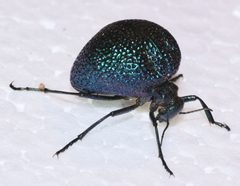
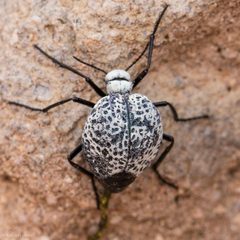
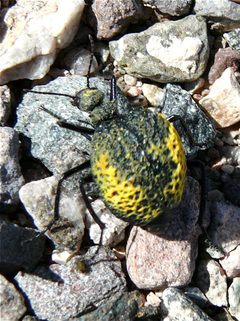
Cysteodemus is a of desert in the Meloidae, containing at least two described : C. armatus (inflated ) and C. wislizeni (black bladder-bodied meloid). The genus is characterized by a highly inflated, bladder-like body form that gives these beetles their . Species are found in arid and semi-arid regions of the southwestern United States and adjacent Mexico. Sexual in Cysteodemus represents an intermediate condition between the two major of blister beetles, featuring simple courtship, prolonged mating, and high female receptivity.
Pronunciation
How to pronounce Cysteodemus: //sɪˌstoʊˈdiːməs//
These audio files are automatically generated. While they are not always 100% accurate, they are a good starting point.
Identification
The extremely inflated, bladder-like body form is diagnostic for the . C. wislizeni (black bladder-bodied meloid) is uniformly black, while C. armatus (inflated ) has distinct markings. The genus can be distinguished from other Eupomphini by the degree of body inflation and the resulting rounded, globular silhouette.
Images
Habitat
Arid and semi-arid regions including desert scrub, sand dunes, and dry grasslands. Associated with gypsum/red siltstone slopes, saltbush chaparral, and mesquite-dominated vegetation. In New Mexico, found in Bottomless Lakes State Park among Allionia incarnata and Kallstroemia parviflora on gypsum/red siltstone slopes.
Distribution
Southwestern United States and adjacent Mexico. Documented from New Mexico (Chaves County, Eddy County, Roosevelt County), Texas (western Texas), Arizona (southeastern Arizona), Oklahoma panhandle, and Kansas.
Seasonality
active from late spring through fall. Observed in September in New Mexico, July in Texas, and late summer/fall periods. Activity appears to peak in late summer months.
Host Associations
- Tribulus terrestris - floral observed feeding on flowers; multiple individuals found perched on foliage and consuming flowers in New Mexico
- Allionia incarnata - associated vegetation found crawling on ground among this trailing four o'clock in New Mexico
- Kallstroemia parviflora - associated vegetation found in with this small-flowered carpetweed in New Mexico
- Solanum elaeagnifolium - associated vegetationMultiple found crawling on roadsides in patches of this silverleaf nightshade
Behavior
Sexual includes simple courtship lacking elaborate tactual display, prolonged mating period with male remaining mounted on female, high female receptivity regardless of previous mating history, and postcopulatory behavior. are active on the ground and on low vegetation, particularly at night. Attracted to light sources. Adults have been observed scavenging or feeding on floral resources.
Similar Taxa
- EupomphaBoth are in tribe Eupomphini and share some body form characteristics, but Eupompha is less inflated and has different coloration patterns
- Other MeloinaeCysteodemus sexual represents an intermediate condition between typical Meloinae and Nemognathinae, with simpler courtship than most Meloinae
- NemognathinaeSexual in Cysteodemus is intermediate between Meloinae and Nemognathinae, lacking the elaborate tactual displays of some nemognathines
More Details
Sexual behavior significance
The sexual of Cysteodemus is of phylogenetic interest as it represents an intermediate condition between the two major of blister beetles, suggesting evolutionary transitions in mating systems within Meloidae.
Historical taxonomy
The was established by J.L. LeConte in 1851, with both currently recognized described in the same publication.