
Cis chinensis
Lawrence, 1991
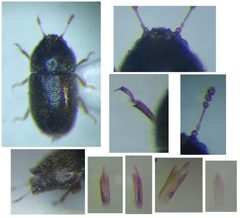
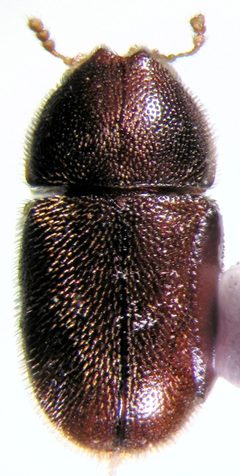
Cis chinensis is a minute beetle in the Ciidae (minute tree-fungus beetles), first described from China in 1991. It has become established as an in Europe, with confirmed in Switzerland and Germany. The is primarily known as a storage pest of commercially dried fungi, but wild populations have been found living on bracket fungi growing on trees in urban environments. exhibit size plasticity in response to temperature, and the species serves as for specialized and phoretic mites.

Pronunciation
How to pronounce Cis chinensis: /sɪs kɪˈnɛn.sɪs/
These audio files are automatically generated. While they are not always 100% accurate, they are a good starting point.
Images
Habitat
Urban and semi-urban environments; specifically found on fruitbodies of bracket fungi (Polyporales) growing on trees. In Basel, Switzerland, established on Antrodia xantha fungus on Pinus strobus in a therapy garden setting. Also occurs in commercial storage facilities for dried fungi.
Distribution
Native to China; in Europe with established in Switzerland (Basel) and Germany (low mountains). GBIF records indicate presence in Brazil (Minas Gerais) and France.
Diet
Fungal fruitbodies, specifically bracket fungi (Polyporales: Fomitopsidaceae). Known : Antrodia xantha.
Host Associations
- Antrodia xantha - fungus - fruitbody substratePolyporales: Fomitopsidaceae; primary in European
- Pinus strobus - tree of fungal substrateeastern white pine; tree for Antrodia xantha in Basel
- Cleruchus breviclava - Mymaridae fairyfly; newly described from Basel
- Histiostomatidae - phoretic mitesunusually heavy observed on Basel ; mites use as carrier
Life Cycle
(4–)5 larval stages postulated for larval development. Developmental timing appears temperature-sensitive; above-average June temperatures correlated with larger size in second cohort.
Behavior
exhibit size plasticity in response to environmental temperature. Heavy phoretic mite noted in wild , with Histiostomatidae mites using the as a carrier organism.
Ecological Role
Human Relevance
Storage pest of commercially dried fungi. in Europe with potential ecological impacts on native fungal and associated fauna.
Sources and further reading
- BugGuide
- GBIF taxonomy match
- iNaturalist taxon
- NCBI Taxonomy
- Meloidae Holdings | Entomology Research Museum
- Rookies use Cookies in Science Alliance to Track Ants' Advance
- A Fast, Frassy Way to Detect the Asian Longhorned Beetle
- Stylish Lepidoptera: Ermine Moth, Atteva aurea; Yellow-Collared Scape Moth, Cisseps fulvicollis; Pearl Crescent, Phyciodes tharos; Variegated Fritillary, Euptoieta claudia — Bug of the Week
- What Puts the Blister Into Blister Beetles?
- Next Time You Eat a Kiwifruit, Don't Thank a Bee
- Der Fremdling im Therapiegarten – Cis chinensis (Coleoptera, Ciidae) und sein Umfeld
- A new species of Cleruchus (Hymenoptera, Mymaridae), an egg parasitoid of the invasive Cis chinensis (Coleoptera, Ciidae) in Switzerland, with new records of other congeners in Europe