
Histiostomatidae
Berlese, 1897
Genus Guides
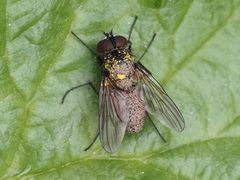
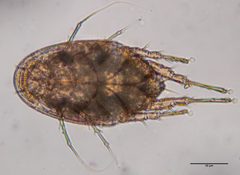
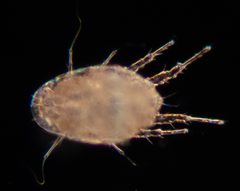
2Histiostomatidae is a of small astigmatid mites (600–900 μm) characterized by highly modified mouthparts adapted for feeding on bacteria and microorganisms. A defining feature is the heteromorphic deutonymph stage, specialized for phoretic on . These mites occupy patchy, ephemeral including carrion, , compost, water-filled tree hollows, and pitcher plant fluids. Many are associated with bark beetles, flies, and other insects, with some showing specific phoretic relationships. The family has forensic relevance through carrion-associated species that can aid postmortem interval estimation.
Pronunciation
How to pronounce Histiostomatidae: //ˌhɪstioʊˌstoʊməˈtaɪdiː//
These audio files are automatically generated. While they are not always 100% accurate, they are a good starting point.
Identification
Histiostomatidae can be distinguished from other Astigmata by the combination of: (1) reduced digitus mobilis with complex membranous structures forming a bacterial-filtering apparatus; (2) presence of a heteromorphic, non-feeding deutonymph (hypopus) with sucker plates for phoretic transport; and (3) association with decaying organic matter or specific microhabitats like pitcher plants. Within the , are distinguished by deutonymph , particularly gnathosoma shape and leg modifications—Xenanoetus shows enlarged gnathosoma with double claws on legs I–III and broadened /genu of legs I–II; Hormosianoetus and Creutzeria are specialized for aquatic or semi-aquatic .
Images
Habitat
Patchy, ephemeral microhabitats rich in microorganisms: animal , compost, vertebrate carrion, decaying fungi and mushrooms, water-filled tree hollows, and the digestive fluids of pitcher plants (Nepenthes, Sarracenia). Some inhabit bark beetle galleries in dead or dying wood. The shows extreme specialization, with individual species often restricted to specific substrate types.
Distribution
distribution with records from 31 countries across all continents except Antarctica and South America (for bark beetle-associated ). Documented from: Europe (widespread, including Spain, France, Germany, Hungary, UK), Asia (Mongolia, Japan, Sakhalin, Saudi Arabia), North America (USA, Canada), and South America (Argentina). Specific distributions vary by ; Xenanoetus species previously known only from northern hemisphere.
Seasonality
Activity patterns tied to substrate availability and temperature. Deutonymph formation in Histiostoma feroniarum triggered at thermal extremes: below 16°C or above 31°C. Carrion-associated follow fly seasonality. Pitcher plant inhabitants active year-round within fluid microhabitat. Bark beetle associates synchronized with periods.
Diet
Microorganisms, primarily bacteria, filtered from substrate surfaces using modified mouthpart apparatus. Some feed on fungal and fruiting bodies (e.g., Histiostoma feroniarum on cultivated mushrooms). Feeding mechanism involves scooping bacterial films rather than piercing or sucking. Competitors with other microbivores in shared .
Host Associations
- Synthesiomyia nudiseta - phoreticMyianoetus muscarum deutonymphs attach near calypters for transport to carrion
- Compsomyiops fulvicrura - phoreticMyianoetus sp. deutonymphs; first documented association for this calliphorid
- Sphaeroceridae - phoreticXenanoetus use lesser dung flies for
- Hydrophilidae - phoreticXenanoetus also phoretic on water scavenger beetles
- Scolytinae - commensal or mutualisticHistiostoma inhabit bark beetle galleries; may fungal spores including Ophiostoma, Ceratocystis, Alternaria
- Polygraphus proximus - commensalHistiostoma shiramba described from galleries of this bark beetle
- Ips sexdentatus - commensalHistiostoma ovalis associated with this scolytine
- Titanolabis colossea - phoretic or commensalAustralian giant Histiostomatidae mites
- Endonepenthia schuitemakeri - potential Phorid fly in pitcher plants; Creutzeria mites not confirmed to use this for
- Humans - accidentalSingle case of otoacariasis reported from Saudi Arabia; Loxanoetus-related
Life Cycle
Holomorphic with facultative heteromorphic deutonymph. Typical stages: , larva, , deutonymph (feeding or non-feeding hypopus), tritonymph, . The deutonymph is polymorphic: (1) a feeding, non- form in stable , or (2) a non-feeding, phoretic hypopus with sucker plates and regressed mouthparts triggered by temperature stress, overcrowding, or habitat deterioration. Phoretic deutonymphs seek , attach via sucker plates, and resume development upon reaching new substrate. Development time highly temperature and food-dependent: Histiostoma feroniarum completes stages in 4.3–17.1 days depending on mushroom host and temperature (19–28°C).
Behavior
is the primary strategy: deutonymphs actively seek and attach to mobile arthropods solely for transportation, without feeding on the . Some show 'leg-crossing' locomotion where legs I and II move asynchronously. Swimming documented in pitcher plant inhabitants (Creutzeria spp.). Bonomoia opuntiae exhibits unusual substrate penetration into muddy layers. Mites fungal spores on their bodies, potentially influencing fungal composition in bark beetle galleries. Strong intraspecific and interspecific food competition; most species cannot be cultured together due to overlapping resource requirements.
Ecological Role
Microbial grazers regulating bacterial and fungal in ephemeral . Phoretic vectoring of fungi, including tree (blue-stain fungi Ophiostoma, Ceratocystis) and potentially beneficial . Nutrient cycling in decomposition systems: carrion, , and plant detritus. In pitcher plants, Creutzeria mites compete with microbes for prey-derived nitrogen, with neutral to negative effects on plant nutrient . Food source for predatory mites and other small in microhabitats.
Human Relevance
Forensic significance: carrion-associated (Myianoetus muscarum, Xenanoetus spp.) provide supplementary evidence for postmortem interval estimation, with deutonymph arrival and development adding temporal resolution beyond insect . Agricultural pest: Histiostoma feroniarum damages cultivated mushrooms by feeding on and fruiting bodies, transmitting . Medical: single reported case of human ear canal (otoacariasis) in Saudi Arabia. Potential utility in forensic remains underexploited due to taxonomic neglect.
Similar Taxa
- AcaridaeSimilar soft-bodied astigmatid mites in decaying matter; distinguished by Histiostomatidae's highly modified cheliceral apparatus and specialized deutonymph
- GlycyphagidaeShare astigmatid characteristics and preferences; Histiostomatidae differ in bacterial-feeding mouthpart specialization and phoretic deutonymph structure
- ErythraeidaeAlso found on ; erythraeids are parasitic larvae (often red, large) rather than phoretic deutonymphs, and belong to Prostigmata not Astigmata
Misconceptions
The deutonymph was historically termed 'hypopus' and considered a distinct resting stage; it is now recognized as a facultative, environmentally triggered morph. is often confused with ; histiostomatid deutonymphs do not feed on their carriers. The was previously assumed to feed directly on fungi; mouthpart indicates bacterial filtration from substrate surfaces, with limited to specific .
More Details
Forensic potential
Pimsler et al. (2016) documented Myianoetus muscarum on human remains in Texas, establishing baseline for mite-based postmortem interval estimation. Mite on carrion remains largely unstudied compared to insects.
Taxonomic challenges
Many described only from deutonymphs (hypopi), with stages unknown; this complicates identification and ecological interpretation. Recent redescriptions based on complete (e.g., Histiostoma ovalis, H. shiramba) improve understanding.
Aquatic specializations
Creutzeria, Hormosianoetus, and Sarraceniopus represent independent adaptations to fluid-filled (pitcher plants, treeholes), with swimming and modified for hydrophobic properties.
Sources and further reading
- BugGuide
- Wikipedia
- GBIF taxonomy match
- iNaturalist taxon
- NCBI Taxonomy
- Catalogue of Life
- Cosmetid harvestman with parasitic/phoretic mites in Argentina | Beetles In The Bush
- Forensic Entomologists Mite Start Looking at Acarids for Clues
- A HUMAN CASE OF OTOACARIASIS INVOLVING A HISTIOSTOMATID MITE (ACARI: HISTIOSTOMATIDAE)
- Food competition and feeding behavior and its implications for the phylogeny of the Histiostomatidae (Astigmata)
- Observations on the Biology of Hormosianoetus mahunkai Eraky and Shoker, 1993 (Acari: Histiostomatidae)
- Mites of the family Histiostomatidae associated with the Australian giant earwig,Titanolabis colossea(Dohrn) (Dermaptera: Anisolabididae)
- Life cycle of Sarraceniopus nipponensis (Histiostomatidae: Astigmata) from the fluid-filled pitchers of Sarracenia alata (Sarraceniaceae)
- Life history and biology ofHormosianoetus mallotae(Fashing) (Histiostomatidae: Astigmata), an obligatory inhabitant of water-filled treeholes
- Association of Myianoetus sp. (Acari: Histiostomatidae) with necrophagous fly Compsomyiops fulvicrura (Diptera: Calliphoridae), in the Prepuna ecoregion (Jujuy: Argentina)
- Feeding observations on two astigmatic mites, Schwiebea rocketti (Acaridae) and Histiostoma bakeri (Histiostomatidae) associated with Citrus feeder roots1
- <p class="Body">A review of histiostomatid mites associated with scolytine bark beetles (Coleoptera: Curculionidae), with a description of Histiostoma shiramba sp. n. (Acari: Histiostomatidae) from galleries of the Sakhalin-fir bark beetle Polygraphus proximus
- New records of Xenanoetus species (Astigmata: Histiostomatidae) in Western Europe, and their association with pig carcasses
- Histiostoma ovalis(Histiostomatidae, Acari) associated withIps sexdentatus(Scolytinae, Curculionidae, Coleoptera): ecology and mite redescription on the basis of formerly unknown adults and nymphs
- Growth, development, and host preference of Histiostoma feroniarum (Acaridida: Histiostomatidae): effects of temperature and types of mushroom cultivar
- Ecology and natural history of swimming pitcher mites (Creutzeria spp., Histiostomatidae) from the traps of Nepenthes pitcher plants
- Redescription ofMyianoetus muscarum(Acari: Histiostomatidae) Associated with Human Remains in Texas, USA, with Designation of a Neotype from Western Europe