
Glycyphagidae
glycyphagid mites, storage mites
Genus Guides
1- Glycyphagus(Grocer's Itch Mites)
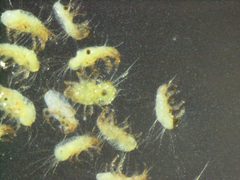
is a of mites in the order Sarcoptiformes (Astigmata), comprising more than 25 and approximately 100 described . Many species are associated with nests of rodents, , opossums, and birds, while others have become pests of stored food products and human dwellings. Several species, including ** and *Lepidoglyphus destructor*, are economically significant as stored grain pests and sources of allergens.
Pronunciation
How to pronounce Glycyphagidae: //ˌɡlaɪsɪˈfæɡɪdiː//
These audio files are automatically generated. While they are not always 100% accurate, they are a good starting point.
Identification
mites are distinguished from related in the Astigmata by a combination of morphological features of the idiosoma and legs. Specific identification requires examination of setal patterns, solenidia, and other microsculpture under compound microscopy. The family includes both free-living and phoretic , with some exhibiting distinct morphological adaptations for via mammal .
Images
Habitat
Natural include nests of small mammals (rodents, , opossums) and birds. Many have colonized anthropogenic environments, occurring in stored grain, cereals, hay, and house dust. Specific documented habitats include farm buildings, stored substrates, and bird nests in Poland (Upper Silesia region).
Distribution
Worldwide distribution with records from Europe (Denmark, Norway, Sweden, Poland), North America, and other regions. Specific regional records include Upper Silesia, Poland (Solarnia near Lubliniec, Tychy, Laziska Górne).
Diet
Feeding habits are poorly documented at the level. Individual are associated with organic debris in nests and stored products; specific dietary items are not established.
Host Associations
- rodents - nest associatenatural
- insectivores - nest associatenatural
- opossums - nest associatenatural
- birds - nest associatedocumented from 12 bird in Poland
- mammals - phoretic Glycyphagus hypudaei recorded as phoretic fur mite
Life Cycle
Development includes , larval, nymphal (including hypopus stage in some ), and stages. In **, egg development is most rapid at 24.4°C, with optimum temperature for post-embryonic stages at 22.2°C. Hypopus formation in this species is more frequent at 70–75% relative humidity than at 95–100% r.h. In *Lepidoglyphus destructor*, development ceases at 30°C; hypopi are produced at 14°C but not at 20–25°C. In *Aëroglyphus robustus*, duration is shorter at 70–75% r.h. than at 85–90% r.h., with higher egg production at 28°C and 85–90% r.h.
Behavior
Some exhibit phoretic , using mammal for . The hypopus stage serves as a dispersal and form in several species.
Ecological Role
Decomposers in nest ; contribute to allergen loads in bird nests and stored products. Serve as food source for other arthropods in these microhabitats.
Human Relevance
Several are significant pests of stored grain and cereals (**, *Lepidoglyphus destructor*). These and other glycyphagid mites are important sources of allergens in agricultural and domestic settings, contributing to respiratory allergies among farmers and other exposed individuals. *Glycyphagus domesticus* has been identified as an allergenic species in bird nests in Poland.
Similar Taxa
- PyroglyphidaeAlso contains allergenic ; distinguished by morphological features of the legs and idiosoma, and by preferences ( more strongly associated with human dwellings rather than stored products and nests)
- AcaridaeOverlaps in stored product ; Acaridae typically have different cheliceral and leg setation patterns, and some (e.g., *Tyrophagus*) show different reproductive rates and humidity tolerances
More Details
Reproductive biology
Net reproductive rates vary considerably among studied : *Lepidoglyphus destructor* achieves 53–55 females per female per at optimal temperatures (14°C and 25°C at 75% r.h.); ** has intermediate rates of over 20; *Aëroglyphus robustus* shows low net rates.
Environmental tolerances
show distinct optima for temperature and humidity. *Lepidoglyphus destructor* tolerates cooler conditions (14°C) better than warm (30°C lethal). ** hypopus formation is humidity-dependent. These tolerances influence pest status in different storage conditions.
Sources and further reading
- BugGuide
- Wikipedia
- GBIF taxonomy match
- iNaturalist taxon
- NCBI Taxonomy
- Catalogue of Life
- Life cycle ofOrycteroxenus galemyssp. nov. (astigmata: Glycyphagidae)
- Allergenic mites associated with bird nests in Poland (Astigmata: Pyroglyphidae, Acaridae, Glycyphagidae)
- EFFECT OF HUMIDITY AND TEMPERATURE ON THE BIOLOGY OF AËROGLYPHUS ROBUSTUS (BANKS) (ACARINA: GLYCYPHAGIDAE)
- New State and Host Records for the Phoretic Fur Mite, Glycyphagus hypudaei (Acari: Glycyphagidae)
- Bionomics of Lepidoglyphus destructor (Schrank) (Acarina: Glycyphagidae), a pest of stored cereals
- Bionomics of Glycyphagus domesticus (de Geer) (Acarina: Glycyphagidae), a pest of stored grain