
Tyrophagus
Oudemans, 1924
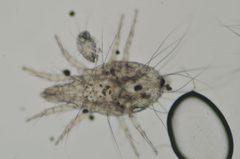
Tyrophagus is a of mites in the Acaridae, containing at least 17 described . The genus includes economically significant pests such as Tyrophagus putrescentiae (the mould mite or cheese mite) and T. neiswanderi, which infest stored products, ornamental plants, and laboratory cultures. Several species are known to disseminate fungi and bacteria, causing damage in plant tissue culture facilities and food storage environments. Members of this genus exhibit rapid growth under favorable conditions, with times of approximately 29 days and high reproductive rates.
Pronunciation
How to pronounce Tyrophagus: /ˌtɪr.oʊˈfæɡəs/
These audio files are automatically generated. While they are not always 100% accurate, they are a good starting point.
Images
Habitat
Stored products; plant tissue culture laboratories; ornamental plants; culture conditions with associated fungi. Specific associations vary by : T. putrescentiae commonly occurs in stored food products and laboratory settings, while T. neiswanderi has been documented on ornamental plants.
Distribution
Recorded from Rica (Central Valley); Denmark; Norway; Sweden; British Isles (Great Britain). Broader distribution as stored product pests is implied but not explicitly documented in available sources.
Diet
Fungi, including Leptosphaerulina sp. (documented as food source for T. putrescentiae in laboratory culture). Diet likely varies by and ; stored product species presumably feed on moulds and organic debris.
Host Associations
- Leptosphaerulina sp. - food sourceAssociated fungus used in laboratory rearing of T. putrescentiae
- ornamental plants - T. neiswanderi and T. putrescentiae documented as pests of ornamental plants
- fungi - T. putrescentiae disseminates fungi in plant tissue culture laboratories
- bacteria - T. putrescentiae disseminates bacteria in plant tissue culture laboratories
Life Cycle
(4.52–4.54 days) → larva (1.44–1.57 days) → (1.31–1.37 days) → tritonymph (1.29–1.45 days) → . Pre-oviposition period: 1.86 days; oviposition period: 7.21 days; post-oviposition period: 1.35 days. time: 29.47 days. Data derived from laboratory studies of T. putrescentiae; field may differ.
Behavior
Rapid multiplication: T. putrescentiae can multiply its initial population in a single day under favorable laboratory conditions, leading to population explosions. Disseminates fungi and bacteria in plant tissue culture environments.
Ecological Role
Pest of stored products and ornamental plants; biological for fungal and bacterial dissemination in laboratory and agricultural settings. Serves as prey for predatory mites such as Blattisocius mali.
Human Relevance
Economic pest in food storage and plant tissue culture facilities. T. putrescentiae known as the cheese mite or mould mite. Potential target for using predatory mites.
Sources and further reading
- BugGuide
- Wikipedia
- GBIF taxonomy match
- iNaturalist taxon
- NCBI Taxonomy
- Catalogue of Life
- The influence of different host plants on the reproductive potential of Tyrophagus putrescentiae (Schrank) and Tyrophagus neiswanderi Johnston and Bruce (Acaridae)
- The ecology of a field population of Tyrophagus putrescentiae (Acari: Acaridida)
- In vitro life table of the storage mite Tyrophagus putrescentiae (Acari: Acaridae)
- The age-specific functional response of Blattisocius mali (Acari: Mesostigmata) preying on the acarid mite Tyrophagus putrescentiae