
Synthesiomyia nudiseta
(Wulp, 1883)
Synthesiomyia nudiseta is a large muscid fly (7–10 mm) and the sole in its . It is necrophagous and facultatively predatory, with larvae known to consume other necrophagous fly larvae including Chrysomya rufifacies and C. albiceps. The species is forensically significant due to its predictable and tendency to pupate in confined locations near carcasses, such as within clothing. Originally tropical and subtropical in distribution, it has established in southwestern Europe (Spain, Italy, Portugal) and occurs in the southern United States.
Pronunciation
How to pronounce Synthesiomyia nudiseta: //sɪnˌθɛsi.oʊˈmaɪə ˌnjuːdɪˈsiːtə//
These audio files are automatically generated. While they are not always 100% accurate, they are a good starting point.
Identification
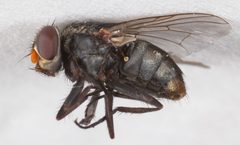
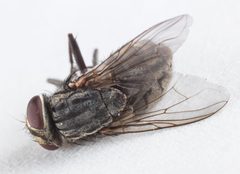
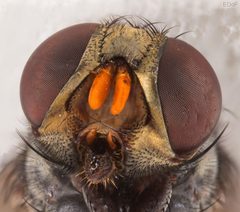
are among the largest Muscidae (7–10 mm). The is gray with a checkerboard pattern resembling flesh flies (Sarcophagidae), but differs in having four longitudinal thoracic stripes and a yellow (not red) terminal abdominal segment. and palpi are orange or yellow. Key diagnostic features include (feathery) three-segmented , well-developed calypters, and multiple sternopleural bristles. have S-shaped slits with a highly chitinized complete peritreme. Larvae are unusually large and predacious; second instar larvae possess a distinct parastomal —an unusual identifying characteristic for the .
Images
Habitat
Associated with decomposing vertebrate remains, including human corpses. Highly in some regions; prefer direct sunlight and are usually found outdoors. In Brazil, notably common in urban Rio de Janeiro. occurs in confined locations near food sources, including within clothing (elastic waistbands, inner surfaces) and between bodies and substrate.
Distribution
Native to tropical and subtropical regions. In the United States: California to Texas and North Carolina to Florida. In Europe: introduced recorded in Portugal, Spain, and Italy, with forensic case documentation from Madrid and Alicante. Also recorded from Brazil (Rio de Janeiro, Pernambuco, Paraná), Rica, Malaysia, Hawaii, Azores, Madeira, and Galápagos Islands.
Diet
Larvae are primarily necrophagous, feeding on carrion. They feed at the surface of food substrates rather than burrowing. Larvae are facultatively predatory, consuming larvae of other necrophagous flies including Chrysomya rufifacies, C. albiceps, Lucilia sericata, and Calliphora vicina. feed on liquids associated with decomposition.
Life Cycle
to development ranges from 15.4 days at 30°C to 46.5 days at 15°C; at 25–31°C (optimal range), 22–30 days. includes three larval instars: first instar (~24 hours, 1.5–3 mm, ~65% survival rate), second instar (~48 hours, 3–7 mm, high viability), and third instar (230 hours feeding stage, 7–19.5 mm, followed by wandering pre-pupal stage). Larvae produce a silky white secretion from salivary glands that solidifies into a protective cocoon around the (7–8 mm, brown-red). occurs close to food sources; the can successfully pupate in confined spaces. Four to nine per year possible depending on temperature.
Behavior
are and prefer direct sunlight. Larvae exhibit surface-feeding on carrion rather than burrowing. Larvae are facultatively predatory, actively consuming competitor larvae. behavior is distinctive: larvae do not migrate far from food, instead pupating in restricted locations such as clothing crevices and body-substrate interfaces. The is phoretically associated with the mite Myianoetus muscarum, which attaches to adult flies for transport to new carrion sources.
Ecological Role
Intraguild in sarcosaprophagous ; significantly impacts community structure through on blowfly larvae. Competitor with other necrophagous Diptera, affecting their developmental timing and size through exploitative and interference competition. Serves as a for the Pachycrepoideus vindemmiae. Acts as a phoretic host for Myianoetus muscarum mites, facilitating mite to ephemeral carrion resources.
Human Relevance
Primary forensic importance: used in postmortem interval (PMI) estimation based on predictable timing and developmental rates. First arrivals on carcasses with slower larval development than competing , creating distinct patterns. in clothing and confined spaces requires careful evidence collection near bodies. potential in Europe with established in Mediterranean regions.
Similar Taxa
- Sarcophagidae (flesh flies)Similar checkerboard abdominal pattern; distinguished by S. nudiseta having four thoracic stripes, yellow (not red) terminal abdominal segment, and .
- MuscinaClosely related ; differs in precise details of larval and and geographic distribution.
- Chrysomya albicepsCo-occurs on carcasses and is also facultatively predatory; distinguished by -level characters (Calliphoridae vs. Muscidae) and larval .
Sources and further reading
- BugGuide
- Wikipedia
- GBIF taxonomy match
- iNaturalist taxon
- NCBI Taxonomy
- Catalogue of Life
- Forensic Entomologists Mite Start Looking at Acarids for Clues
- Synthesiomyia nudiseta Archives - Entomology Today
- Myianoetus-muscarum-on-Synthesiomyia-nudiseta-wp - Entomology Today
- Predatory behavior of Synthesiomyia nudiseta larvae (Diptera: Muscidae) on several necrophagous blowfly species (Diptera: Calliphoridae)
- Post-mortem Interval Estimation in a Forensic Case with Two Predatory Species: Chrysomya albiceps and Synthesiomyia nudiseta
- On the life history of Synthesiomyia nudiseta van der Wulp (Diptera, Muscidae), a myiasis-producing fly
- First report of the parasitoid Pachycrepoideus vindemmiae (Rondani, 1875) (Hymenoptera: Pteromalidae) parasitizing Synthesiomyia nudiseta (Van der Wulp, 1883) (Diptera: Muscidae)
- Developmental rate of Synthesiomyia nudiseta (van der Wulp, 1883) (Insecta, Diptera, Muscidae), a species of forensic importance, under alternating temperature
- Larval morphology, development and forensic importance ofSynthesiomyia nudiseta(Diptera: Muscidae) in Europe: a rare species or just overlooked?
- First Life Table ofSynthesiomyia nudiseta(Diptera: Muscidae) From Palearctic Region for Analyzing the Effect on Its Dispersal Ability