
Sepedophilus testaceus
(Fabricius, 1792)
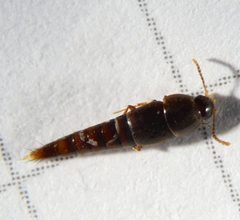
Sepedophilus testaceus is a small rove beetle (Staphylinidae: Tachyporinae) originally described from Europe and now established in North America as an introduced . The species has undergone taxonomic revision, with several previously described North American species (imbricatus, limuloides, elongatus) synonymized under this name. Larvae possess specialized morphological adaptations on the that facilitate prey capture. are associated with decaying organic matter and fungal .
Pronunciation
How to pronounce Sepedophilus testaceus: /sɛˌpiːdəˈfɪləs tɛsˈteɪsiəs/
These audio files are automatically generated. While they are not always 100% accurate, they are a good starting point.
Identification
can be distinguished from other North American Sepedophilus by male genitalia and the structure of the eighth abdominal sternites and tergites. The species belongs to a species group characterized by specific morphological traits defined in the revision. Larvae are identifiable by specialized abdominal adapted for prey capture.
Images
Distribution
Native to Europe, Russia (including Siberia and the Far East), North Africa (Morocco, Algeria, Tunisia), the Middle East (Turkey, Cyprus, Armenia, Azerbaijan, Iran, Saudi Arabia), and Asia (Afghanistan, Japan, China, Taiwan). Introduced to North America, established in Canada (Alberta, New Brunswick, Newfoundland, Nova Scotia, Ontario, Quebec, Saskatchewan) and widespread in the United States. Also recorded from Atlantic islands including Madeira and the Azores (Flores, Graciosa, Pico, São Miguel).
Behavior
Larvae exhibit prey-capture facilitated by specialized morphological structures on the . The specific mechanics of this prey-capture behavior have been documented in morphological studies.
Similar Taxa
- Sepedophilus littoreusHistorically confused due to synonymy of knoxii and carissimus with littoreus; distinguished by male genitalia and abdominal sternite/tergite structure
- Sepedophilus cinctulusFormerly synonymized under opicus; now recognized as valid with distinct distribution and diagnostic characters
- Sepedophilus opicusNeotype designated for this ; previously confused with cinctulus in literature
More Details
Taxonomic History
The North American fauna of Sepedophilus was extensively revised, resulting in the synonymy of imbricatus Casey, limuloides Casey, and elongatus Blatchley under S. testaceus. The is placed in one of 12 defined species groups based on examination of Nearctic, Neotropical, and Palearctic faunas.
Nomenclatural Notes
The generic group names Sepedophilus Gistel, Conurus Stephens, Conosoma Kraatz, and Conosomus Motschulsky have been discussed in relation to this . The basionym Oxyporus testaceus Fabricius, 1792 reflects its original placement.
Sources and further reading
- BugGuide
- GBIF taxonomy match
- iNaturalist taxon
- NCBI Taxonomy
- Catalogue of Life
- ID Challenge #2 | Beetles In The Bush
- Biological aspects of the larva of Sepedophilus testaceus (Coleoptera: Staphylinidae, Tachyporinae): morphology of the posterior abdomen and prey-capture behaviour
- A REVISION OF THE GENUSSEPEDOPHILUSGISTEL (COLEOPTERA: STAPHYLINIDAE) OF AMERICA NORTH OF MEXICO