
Tasgius ater
(Gravenhorst, 1802)
Large rove beetle
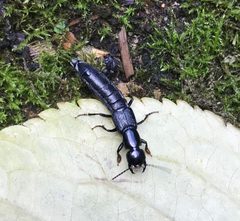
Tasgius ater is a large rove beetle in the Staphylinidae, native to Europe and now introduced to North America, Australia, and New Zealand. It is among the larger in this diverse family and exhibits typical rove beetle with shortened exposing most of the . The species has expanded its range significantly in North America since first detected in the 1930s.
Pronunciation
How to pronounce Tasgius ater: /ˈtæsdʒiəs ˈeɪtər/
These audio files are automatically generated. While they are not always 100% accurate, they are a good starting point.
Identification
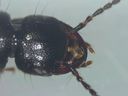
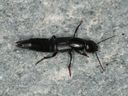
Tasgius ater is a large rove beetle, distinguishable from smaller staphylinids by its body size. It can be separated from the similar introduced Tasgius winkleri by subtle morphological characters including details of setal placement and body proportions; accurate identification typically requires examination of minute characters or expert confirmation. Males possess dilated front (expanded 'feet'). The has the characteristic rove beetle form: elongated body with short that leave most of the abdominal segments exposed.
Images
Distribution
Native to Europe, with records from Austria, Belgium, Belarus, Czech Republic, Germany, England, Finland, France, Great Britain, Georgia, Hungary, Ireland, Italy, Latvia, Lithuania, Luxembourg, Moldova, Netherlands, Norway, Poland, Portugal, Slovakia, Spain, Sweden, Switzerland, Ukraine, and Russia (European part). Also recorded from North Africa (Egypt, Tunisia, Algeria, Morocco, Canary Islands), Turkey, Iran, and Syria. Introduced to North America (Canada: British Columbia, New Brunswick, Newfoundland, Nova Scotia, Ontario, Prince Edward Island, Quebec; USA: widespread), Australia, and New Zealand.
Human Relevance
Tasgius ater is a , meaning it is seldom found far from human habitation and thrives in heavily disturbed . It has been recorded from gardens, neighborhood parks, leaf litter, and moist near wetlands. The species was first reported in the United States in New York in 1938 (likely present by 1931) and has since spread across much of North America. Its spread pattern suggests ongoing range expansion in introduced regions.
Similar Taxa
- Tasgius winkleriSimilar large rove beetle, also introduced from Europe to North America; distinguished by subtle morphological characters including setal patterns and body proportions, historically confused under the name Tasgius globulifer before taxonomic splitting in 1987
- Platydracus speciesOther large native rove beetles that Tasgius ater may be mistaken for by observers unfamiliar with staphylinid diversity; differ in body shape, coloration, and genitalic characters
Sources and further reading
- BugGuide
- Wikipedia
- GBIF taxonomy match
- iNaturalist taxon
- NCBI Taxonomy
- Bug Eric: May 2015
- Bug Eric: A "New" Beetle in Colorado
- A rare opportunity to do fall insect collecting in western North America | Beetles In The Bush
- Nomenclatural changes in Phymatodes | Beetles In The Bush
- Clouded beetles amidst spectacular scenery | Beetles In The Bush
- January | 2014 | Beetles In The Bush