
Cephennium
Müller, P.W.J. & Kunze, 1822
Species Guides
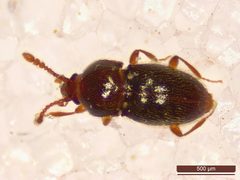
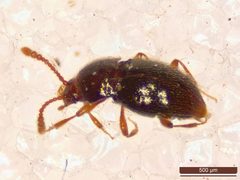
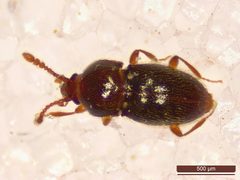
4Cephennium is a of minute rove beetles in the Staphylinidae, Scydmaeninae, first described by Müller and Kunze in 1822. The genus is predominantly western European in distribution but has been recorded across Europe, Northern America, the Middle East, and as far east as Kyrgyzstan. Recent taxonomic work has revealed substantial undescribed diversity, particularly in Turkey where 25 named are now recognized. The genus has been introduced to North America via port cities, with C. gallicum documented from Halifax, Nova Scotia.
Pronunciation
How to pronounce Cephennium: //sɛˈfɛniəm//
These audio files are automatically generated. While they are not always 100% accurate, they are a good starting point.
Images
Distribution
Native to the Palearctic region with records from Europe (including Denmark, Norway, Sweden), Turkey (25 named across multiple provinces), the Middle East (Lebanon, Israel, Jordan, Iraq, Iran), and western Kyrgyzstan (easternmost known locality). Introduced to North America: C. gallicum recorded from Point Pleasant Park, Halifax, Nova Scotia, Canada.
Human Relevance
Documented as an introduced in North America via port cities; C. gallicum serves as a case study for introduction through maritime shipping to the port of Halifax.
More Details
Taxonomic Complexity
Subgeneric classification remains problematic; C. chirgisianum from Kyrgyzstan was deliberately not placed in any subgenus due to unresolved diagnostic issues. The Turkish fauna alone comprises four groups with substantial cryptic diversity—several additional species represented only by females remain undescribed.
Biogeographic Significance
The eastern Kyrgyzstan record represents a major range extension for this predominantly western European , prompting discussion of possible routes and expected occurrence areas in Central Asia.
Sources and further reading
- BugGuide
- Wikipedia
- GBIF taxonomy match
- iNaturalist taxon
- Catalogue of Life
- The Cephennium fauna of Turkey and the Middle East (Coleoptera: Staphylinidae: Scydmaeninae)
- A new Cephennium of Kyrgyzstan, with notes on subgenera and distribution (Coleoptera, Staphylinidae, Scydmaeninae)
- Phloeocharis subtilissima Mannerheim (Staphylinidae: Phloeocharinae) and Cephennium gallicum Ganglbauer (Scydmaenidae) new to North America: a case study in the introduction of exotic Coleoptera to the port of Halifax, with new records of other species