
Cephennium gallicum
Ganglbauer, 1899
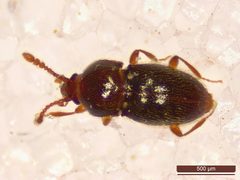
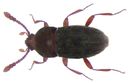
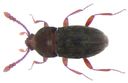
Cephennium gallicum is a minute rove beetle in the Scydmaeninae, native to Europe and first recorded in North America in 2004 from Point Pleasant Park, Halifax, Nova Scotia. The is believed to have been introduced via shipping activity at the port of Halifax. It represents one of several documented cases of Palearctic Coleoptera establishing in North American port cities.
Pronunciation
How to pronounce Cephennium gallicum: /sɛˈfɛniːəm ˈɡælɪkəm/
These audio files are automatically generated. While they are not always 100% accurate, they are a good starting point.
Identification
Cephennium are among the smallest staphylinids, typically under 2 mm in length. C. gallicum can be distinguished from other Cephennium species by genitalic characters and subtle differences in pronotal and elytral ; accurate identification requires microscopic examination. The is characterized by compact body form, short exposing most of the , and with a weakly defined club.
Images
Habitat
In its native European range, C. gallicum inhabits leaf litter, moss, and decaying wood in forested and parkland environments. The Nova Scotia occupies mixed woodland with abundant leaf litter and coarse woody debris in an urban park setting.
Distribution
Native to western and central Europe (Belgium, Germany, France, Great Britain, Ireland, Netherlands, Spain, Sweden, Switzerland). Introduced to North America: established at Point Pleasant Park, Halifax, Nova Scotia, Canada.
Behavior
Has been observed in leaf litter and moss ; exhibits cryptic habits typical of minute litter-dwelling beetles. The Halifax introduction likely occurred via ballast or cargo associated with shipping from European ports.
Ecological Role
Presumed to function as a micro- or scavenger in leaf litter , though specific ecological impacts in the introduced range remain undocumented.
Human Relevance
Documented case study in port-mediated biological invasion; used as an example of how shipping traffic facilitates establishment of Palearctic insects in North America. No known economic or health impacts.
Similar Taxa
- Other Cephennium speciesRequire careful examination of male genitalia and subtle external characters for separation; C. gallicum distinguished by specific aedeagal .
- Other Scydmaeninae genera (e.g., Stenichnus, Euconnus)Similar minute size and preference; distinguished by antennal structure, pronotal shape, and elytral punctuation patterns.
More Details
Introduction pathway
The Halifax is attributed to introduction via the port, with the likely transported in ballast materials, cargo dunnage, or associated plant material from European source populations.
Sources and further reading
- BugGuide
- GBIF taxonomy match
- iNaturalist taxon
- NCBI Taxonomy
- Phloeocharis subtilissima Mannerheim (Staphylinidae: Phloeocharinae) and Cephennium gallicum Ganglbauer (Scydmaenidae) new to North America: a case study in the introduction of exotic Coleoptera to the port of Halifax, with new records of other species