
Scydmaeninae
Leach, 1815
Ant-like Stone Beetles, Scydmaenines
Genus Guides
8- Catalinus
- Cephenniini
- Chevrolatia
- Eutheiini
- Glandulariini
- Leptoscydmus
- Papusus
- Scydmaenus(ant-like stone beetles)
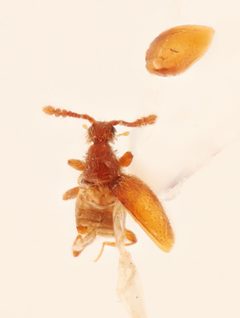
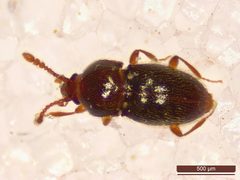
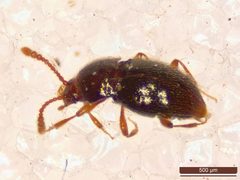
Scydmaeninae is a of minute rove beetles ( Staphylinidae) containing approximately 4,500 in about 80 . Formerly treated as a distinct family, they were reclassified as a subfamily in 2009. Members are commonly known as ant-like stone beetles due to their constricted body shape resembling ants. The subfamily has a worldwide distribution and is divided into four extant supertribes: Cephenniitae, Mastigitae, Scydmaenitae, and the extinct fossil supertribe Hapsomelitae.
Pronunciation
How to pronounce Scydmaeninae: //ˌskaɪd.meɪˈnɪniː//
These audio files are automatically generated. While they are not always 100% accurate, they are a good starting point.
Identification
Distinguished from other Staphylinidae by the combination of extremely small size (often under 2 mm), -like body constrictions, and typically hard, sculptured . The two pronounced waist constrictions separate them from most other rove beetles. Within Scydmaeninae, tribes can be separated by mouthpart specializations: Cephenniini possess paired labial suckers on the prementum; Mastigitae have characteristic antennal structure; Eutheiini and Scydmaenini lack these specializations. Genitalia, particularly structure, are critical for -level identification.
Images
Appearance
Extremely small beetles, with some measuring only 0.5 mm in length. Body typically exhibits pronounced constrictions between and prothorax, and between prothorax and , creating an -like silhouette. generally hard and often sculptured. usually 11-segmented, sometimes with weak club. Elytra short, leaving most of exposed. Legs relatively long and slender. Many species show reduced or absent wings.
Habitat
Primarily inhabit moist microhabitats in forested environments. Most commonly found in leaf litter, rotting logs, and decaying woody debris. Some occur in moss, soil, under stones, or in fungal fruiting bodies. Preference for humid conditions; rarely found in dry or open .
Distribution
Worldwide distribution across all major biogeographic regions. highest in tropical and subtropical forests, with significant representation in temperate zones. Poorly studied in Central Asia, Afghanistan, Pakistan, and parts of the former Soviet republics due to limited field access.
Diet
Predatory, feeding exclusively on mites. Many are strict on heavily sclerotized oribatid or uropodine mites. Different tribes employ distinct feeding strategies: Euconnus species use sticky digestive droplets to capture ptyctimous oribatids; Scydmaenus species use to breach non-ptyctimous oribatids and uropodines, often cutting prey legs; Cephenniini immobilize prey with labial suckers and grind holes in mite .
Host Associations
- Oribatid mites - preyPrimary food source for most ; includes ptyctimous and non-ptyctimous forms
- Uropodine mites - preySecondary prey group for some lineages
Life Cycle
Complete with , larva, pupa, and stages. Larvae are campodeiform (elongate and active). At least one , Stenichnus collaris, has been reared from larva to adult to confirm identification; mature larva described from shed skin. Detailed data remain sparse for most species.
Behavior
Slow-moving, cryptic beetles that remain hidden in substrate. Feeding varies by lineage: some attack mite gnathosoma to access soft tissues; others remove genital or anal plates to feed through openings; specialized forms inject digestive juices and ingest liquefied tissues through punctures. Some species show -specific prey preferences. Cephenniini feeding events may extend over many hours.
Ecological Role
Significant of oribatid and uropodine mite , potentially influencing mite dynamics in forest floor . Role as mite predators may provide ecosystem service in regulating decomposer .
Human Relevance
No direct economic importance. Occasionally encountered by entomologists and naturalists in leaf litter . Some described from historic collections (e.g., John Nietner's Sri Lankan specimens) have required taxonomic revision due to misidentifications.
Similar Taxa
- PselaphinaeAlso small, -like Staphylinidae with constricted bodies; distinguished by different antennal structure and typically more complex foveal patterns on and
- Other Staphylinidae subfamiliesMost lack the pronounced double waist constriction and extreme miniaturization characteristic of Scydmaeninae
More Details
Taxonomic History
Established as Scydmaenidae by Leach in 1815, reduced to status within Staphylinidae in 2009 based on phylogenetic studies.
Fossil Record
Extensive fossil record from Cretaceous amber (Burmese, Spanish, Canadian, French, Russian) and Eocene Baltic and Rovno amber. Extinct supertribe Hapsomelitae known only from Cretaceous fossils.
Research Challenges
Taxonomic difficulties arise from uniform external across many , necessitating dissection and study of genitalia for accurate identification. Historical misidentifications common in museum collections.
Sources and further reading
- BugGuide
- Wikipedia
- iNaturalist taxon
- NCBI Taxonomy
- Catalogue of Life
- Biology of Acarophagous Scydmaeninae
- Three new species of Eutheiini (Coleoptera, Staphylinidae, Scydmaeninae)
- Revision of Cephennomicrus of Australia (Coleoptera, Staphylinidae, Scydmaeninae)
- John Nietner collection of Sri Lankan Scydmaeninae (Coleoptera, Staphylinidae)
- The first species of Scydmoraphes (Coleoptera, Staphylinidae, Scydmaeninae) in China
- Veraphis yoshitomii sp. n. (Coleoptera, Staphylinidae, Scydmaeninae) from Japan
- New synonyms of Euconnus (Tetramelus) kraussi Reitter, 1880 (Coleoptera, Staphylinidae, Scydmaeninae)
- Notes on the systematic placement of Eutheia siamensis Franz (Coleoptera, Staphylinidae, Scydmaeninae)
- The first species of Eutheia (Coleoptera, Staphylinidae, Scydmaeninae) in Pakistan
- Mature larva of Stenichnus collaris (Müller & Kunze) (Coleoptera: Staphylinidae: Scydmaeninae)
- Two new Veraphis species in China (Coleoptera, Staphylinidae, Scydmaeninae)
- First report of subfamily Scydmaeninae (Coleoptera, Staphylinidae) from Shanghai, with description of two new species.
- Two new species of the genus Veraphis Casey (Coleoptera, Staphylinidae, Scydmaeninae) from Korea.