
Cephennium aridum
Hopp & Caterino, 2009
Cephennium aridum is a of minute rove beetle in the Staphylinidae, Scydmaeninae. It was described in 2009 from California and is distinguished by its association with arid . The specific epithet "aridum" refers to the dry conditions of its type locality. Members of this are among the smallest beetles, often less than 2 mm in length.
Pronunciation
How to pronounce Cephennium aridum: //sɛˈfɛniəm ˈærɪdəm//
These audio files are automatically generated. While they are not always 100% accurate, they are a good starting point.
Identification
Identification to requires examination of male genitalia and other fine structural characters; external alone is insufficient. Distinguished from other Cephennium species by subtle differences in aedeagal structure and possibly by its arid preference. Specimens should be compared with type material deposited at the California Academy of Sciences.
Images
Appearance
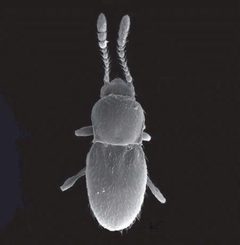
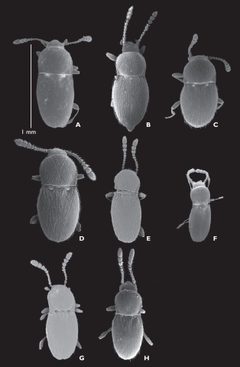
Extremely small , likely under 2 mm in length based on characteristics. Body form compact and rounded, typical of ant-like stone beetles (Scydmaeninae). with distinct clubbed tips. presumably hardened and darkly pigmented. Detailed morphological description requires examination of type material.
Habitat
Arid environments; type series collected from a dry, sandy wash in desert or semi-desert conditions. Specific microhabitat details (e.g., association with soil, leaf litter, or nests) not documented in original description.
Distribution
Known only from California, USA. Type locality: Riverside County, California. No additional records confirmed beyond type series.
Ecological Role
Presumed to function as a micro- or scavenger in soil and litter , as is common for Scydmaeninae, though specific ecological role of this is undocumented.
Similar Taxa
- Cephennium castaneumSimilar size and general appearance; distinguished by aedeagal structure and preference (C. castaneum occurs in more mesic conditions)
- Other Cephennium species in CaliforniaNumerous occur in the region; precise identification requires dissection and comparison with
More Details
Nomenclature
The specific epithet "aridum" is a Latin neuter adjective meaning "dry" or "arid," referring to the dry wash where the type series was collected.
Type Material
and deposited at the California Academy of Sciences (CAS), San Francisco.