
Nicrophorus nigrita
Mannerheim, 1843
Black Burying Beetle
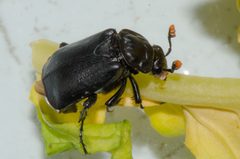
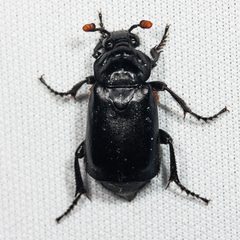
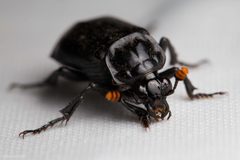
Nicrophorus nigrita, the black burying , is a of carrion beetle described by Mannerheim in 1843. It is distinguished from other Nearctic burying beetles by its uniformly black lacking the typical orange or red markings found in . range from 12–28 mm in length and possess distinctive red-orange antennal clubs. The species occurs along the western coast of North America.
Pronunciation
How to pronounce Nicrophorus nigrita: /nɪˈkrɒfərəs nɪˈɡriːtə/
These audio files are automatically generated. While they are not always 100% accurate, they are a good starting point.
Identification
Distinguished from other North American Nicrophorus by the complete absence of orange or red markings on the . Most in the region display prominent orange or red spots or bands on the wing covers. The red-orange antennal clubs provide the only bright coloration on an otherwise black . The combination of large size (12–28 mm), black elytra, and colored antennal clubs separates this species from all other Nearctic burying beetles.
Images
Habitat
Found in coastal and inland western North American . Occurs in environments where small carcasses are available as breeding resources, including forested areas, coastal scrub, and open habitats. Inland occur through Nevada, suggesting for drier conditions than some coastal .
Distribution
West coast of North America from British Columbia, Canada south to Baja California, Mexico. Inland distribution extends through Nevada. Also recorded from Guadalupe Island. Pleistocene records from California indicate long-term presence in the region.
Diet
Carrion feeder. and larvae consume small vertebrate carcasses. Specific dietary details beyond general carrion association have not been documented for this .
Life Cycle
As with other Nicrophorus , is tied to small vertebrate carcasses. bury carcasses and prepare them as food for larvae. Specific developmental timing for this species is undocumented, but likely parallels with larval development over approximately one to two weeks and in soil.
Behavior
Burying typical of : locate small carcasses using olfactory cues, excavate beneath them to sink the remains into soil, and prepare the carcass as a food source for larvae. Parental care, including carcass preparation and larval feeding, has been observed in but not specifically documented for N. nigrita.
Ecological Role
Carrion scavenger that contributes to decomposition and nutrient cycling. As a burying , it removes small carcasses from the surface, reducing fly breeding sites and accelerating decomposition through burial and processing.
Human Relevance
Contributes to natural decomposition processes. No documented economic importance or pest status. May be encountered by entomologists and naturalists in western North America.
Similar Taxa
- Nicrophorus americanusLarger with prominent orange pronotal patch; federally endangered; restricted to central and eastern North America
- Nicrophorus orbicollisHas orange markings on ; widespread in eastern and central North America
- Nicrophorus tomentosusHas orange and black patterned ; found across much of North America including western regions
- Nicrophorus guttulaHas yellow-orange elytral markings; yellow-bellied burying beetle of coastal California and Pacific Northwest
More Details
Taxonomic note
placement has varied in sources: GBIF and iNaturalist list Staphylinidae, while NCBI and traditional treatments place the in Silphidae. Modern classifications often treat Silphidae as a (Silphinae) within Staphylinidae, accounting for this discrepancy.
Sources and further reading
- BugGuide
- Wikipedia
- GBIF taxonomy match
- iNaturalist taxon
- NCBI Taxonomy
- Congratulations, UC Davis Linnaean Games Team: National Champs! | Bug Squad
- Bohart Museum Spotlight on Yellow-Bellied Burying Beetles | Bug Squad
- They eat dead things - Part I - Burying beetles Silphidae — Bug of the Week
- Phocus on Phyllobrotica | Beetles In The Bush
- Oklahoma is More than OK for Burying Beetles
- Burying Beetles Are Part of Nature's Clean-up Crew