
Chrysina gloriosa
(LeConte, 1854)
glorious beetle, glorious scarab, Glorious Jewel Scarab
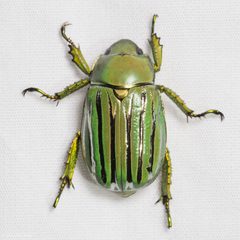
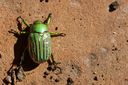
Chrysina gloriosa is a metallic green scarab beetle renowned for its striking iridescent appearance. measure 20–30 mm in length and display bright green with silver longitudinal stripes, though rare red and purple color forms occur. The inhabits sky island mountain ranges in the southwestern United States and northern Mexico, where adults feed primarily on juniper foliage and larvae develop in decaying wood of Arizona sycamore. Active both diurnally and nocturnally, adults are most frequently encountered from June through August and are strongly attracted to ultraviolet light sources. The 's structural coloration arises from cholesteric liquid crystal organization of molecules in the , producing optical properties that change with light angle.
Pronunciation
How to pronounce Chrysina gloriosa: /ˈkrɪsaɪnə ɡlɔːˈriːoʊsə/
These audio files are automatically generated. While they are not always 100% accurate, they are a good starting point.
Identification
Distinguished from other Chrysina by the combination of bright green ground color with distinct silver longitudinal elytral stripes. C. beyeri, which occurs sympatrically in some areas (e.g., Ramsey Canyon, Arizona), differs in color pattern and elytral markings. C. resplendens and other typically lack the sharp silver striping or exhibit different base colors. The structural nature of the coloration—shifting with viewing angle—separates it from pigment-based green scarabs. Size range (20–30 mm) and association with juniper vegetation in sky island provide additional diagnostic context.
Images
Habitat
Montane sky island in the southwestern United States and northern Mexico. strongly associated with juniper trees (Juniperus spp.) for feeding. Larval development occurs in decaying wood, specifically documented from Arizona sycamore (Platanus wrightii). Occurs at moderate to high elevations in mountain ranges that serve as Pleistocene refugia.
Distribution
United States: southeastern Arizona, southern New Mexico, southwestern Texas (including Davis Mountains). Mexico: Chihuahua, Sonora, Coahuila. Distribution restricted to higher elevation mountain ranges; current range represents remnant from more widespread Pleistocene distribution.
Seasonality
active June through August, with peak activity during summer monsoon season. Active both day and night. Strongly attracted to ultraviolet and mercury vapor lights, with peak attraction during first four hours after sundown (approximately 7:00 PM to 11:00 PM).
Diet
feed primarily on juniper leaves (Juniperus spp.). Also visit flowers and act as incidental , transferring pollen while moving between blooms. Larvae feed on decaying wood of Arizona sycamore (Platanus wrightii).
Host Associations
- Juniperus spp. - food sourcePrimary ; foliage consumed
- Platanus wrightii - larval development substrateArizona sycamore decaying wood; larval food and
Life Cycle
Complete with , larva, pupa, and stages. Larvae develop in decaying wood. Specific duration of developmental stages not documented in available sources.
Behavior
climb vegetation to feed on foliage. Strong positive to ultraviolet light sources, making them readily collected at light traps. Adults active both diurnally and nocturnally. When feeding on flowers, individuals transfer pollen incidentally between blooms. activity documented during evening hours.
Ecological Role
Herbivore feeding on juniper foliage. Incidental when visiting flowers. Larval stage contributes to wood decomposition in sycamore logs. Serves as prey for various vertebrate and in sky island .
Human Relevance
Highly sought by professional and amateur collectors worldwide due to striking metallic coloration. Popular in insect collections and occasionally used in biological supply trade. Subject of scientific research on structural coloration and optical properties of biological materials. sequenced to inform conservation decisions and genetics studies. Sometimes incorrectly believed to be endangered; has never been formally assessed by IUCN or listed under U.S. Act. Can be locally abundant where conditions are suitable.
Similar Taxa
- Chrysina beyeriOccurs sympatrically in some localities (e.g., Ramsey Canyon, Arizona); differs in elytral color pattern and markings
- Chrysina resplendensSimilar size and metallic appearance but lacks distinct silver striping on green background
- Other Chrysina speciesApproximately 100+ in ; many exhibit metallic coloration but differ in specific color pattern, geographic distribution, and associations
Misconceptions
Widely but incorrectly believed to have been officially recognized as endangered. The has never been rated by IUCN or listed under the United States Act. This misconception may stem from its restricted range and high desirability among collectors creating perceived rarity.
More Details
Structural coloration mechanism
Iridescence results from cholesteric liquid crystal organization of molecules in elytral , not pigments. This produces angle-dependent optical properties and self-healing Bessel beams from polygonal .
Genomic resources
Near- level assembly available (642 MB, scaffold N50 72 MB, BUSCO 95.5%). Karyotype typical of scarabs with 10 chromosomes. Assembly based on specimen from Davis Mountains, Texas.
Conservation genetics
Research underway to document connectivity and demographic history across sky island ranges. Large- collection impact on populations currently unknown.
Sources and further reading
- BugGuide
- Wikipedia
- GBIF taxonomy match
- iNaturalist taxon
- NCBI Taxonomy
- Catalogue of Life
- Sphecidae | Beetles In The Bush
- Party on a pin oak | Beetles In The Bush
- The gloriously dichromatic Dasymutilla gloriosa | Beetles In The Bush
- A reference quality genome assembly for the jewel scarab Chrysina gloriosa
- Angular distribution of luminescence dissymmetry observed from a random laser built upon the exocuticle of the scarab beetle Chrysina gloriosa